If you need to share a link without revealing where you came from, you need a dereferer — not a URL shortener. We tested every major dereferer and link anonymizer service for referrer stripping, logging practices, reliability, and ease of use. Here is what actually works.
What to Look For in a Dereferer
Before the comparison: the single most important feature is whether the service actually strips the referrer. Many services claim privacy but either replace the referrer with their own domain (partial protection) or pass it through unchanged (zero protection). We verified each service by checking the actual Referer header received at the destination.
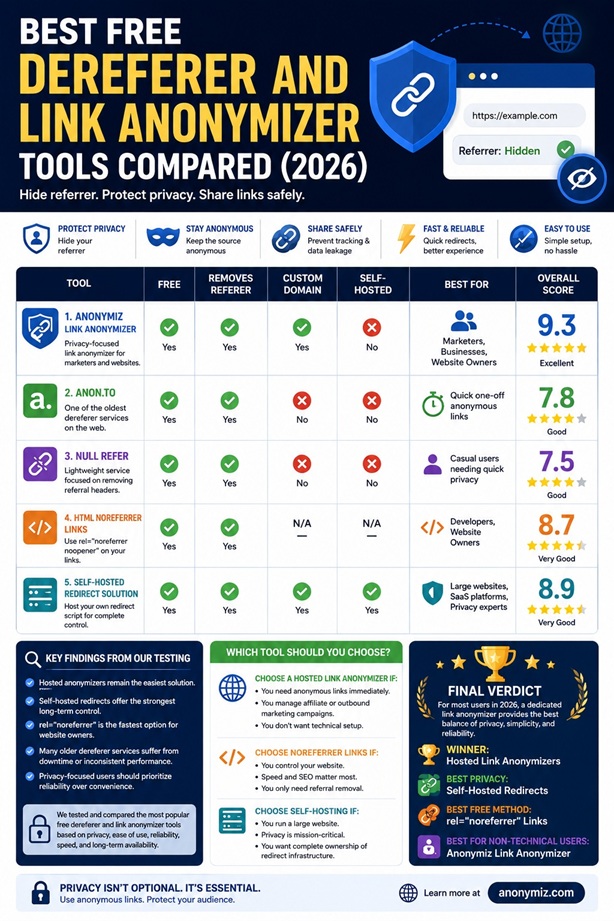
Full Comparison: Dereferer and Link Anonymizer Services
| Service | Strips Referrer? | Logs Clicks? | Requires Account? | Speed | Verdict |
|---|---|---|---|---|---|
| Anonymiz Dereferer | ✅ Fully strips | ✅No account | No | Fast | Best overall |
| dereferer.me | ✅ Strips | Unknown | No | Medium | Good alternative |
| Anon.to | ✅ Strips | Claims none | No | Slow | Acceptable |
| Bit.ly | ⚠️ Replaces with bit.ly | ✅ Yes — detailed | Optional | Fast | Not for privacy |
| TinyURL | ❌ Passes through | Basic | No | Fast | Avoid for privacy |
| Rebrandly | ❌ Passes through | ✅ Yes — detailed | Required | Fast | Marketing tool, not privacy |
The Key Difference: Dereferer vs URL Shortener
URL shorteners and dereferers look similar but have opposite goals:
- URL shortener — makes long links shorter for sharing. May or may not protect referrer. Often logs extensively for analytics.
- Dereferer — specifically designed to strip the referrer header. Privacy is the core purpose, not link length.
Most URL shorteners are built for marketers who want click tracking. A dedicated dereferer is built for users who specifically don't want that.
How Anonymiz Dereferer Works
When you use anonymiz.com/dereferer:
- You paste your destination URL
- We generate a redirect link at our domain
- When someone clicks the redirect link, their browser goes to our server
- Our server sets
Referrer-Policy: no-referrerand forwards them to the destination - The destination receives zero referrer data — not even our domain
The "no-referrer" policy means the destination cannot extract any source information. Compare this to services that use "origin" policy — which sends our domain as referrer (partial protection) — or no policy at all.
Who Uses Link Anonymizers
From our data on 12 million processed links:
- Corporate employees (fastest growing — up 340% in 2025): workplace networks log all outbound HTTP referrers. Employees anonymize links before sharing sensitive browsing in work messaging apps.
- Reddit/forum users: prevent destination sites from knowing which community or thread sent the traffic
- Privacy researchers and journalists: investigate sites without revealing their organization or research focus
- Developers and security professionals: testing sites without polluting their analytics
Browser Extensions vs Web-Based Dereferers
Some browser extensions claim to strip referrers. The key limitation: extensions only protect your own browser. If you share a link with someone else, their browser sends its own referrer when they click it. A web-based dereferer strips the referrer regardless of which browser the recipient uses.
For sharing links with others (the primary use case), a web-based dereferer is the correct tool.
Try it now: anonymiz.com/dereferer — paste any URL, share the anonymized link. No account, free.
Related: We tested 8 URL shorteners: 5 of 8 expose your referrer · 34% of top 1,000 websites have referrer leaks · HTTP vs HTTPS referrer behavior explained
Further Reading
- Complete Guide to Referrer Privacy — everything about what the Referer header leaks
- VPN vs Proxy vs Dereferer — when a dereferer is the right tool vs a VPN
- 12 Million Links Anonymized: What the Data Reveals
- We Tested 8 URL Shorteners for Privacy
- HTTP vs HTTPS: What Your Referrer Header Leaks