
Testing a signup flow usually starts the same way: someone types their own name and email into a form, or reuses "test@test.com" for the hundredth time until the database is full of duplicate rows tied to one real inbox. Neither approach scales, and the first one puts real personal data somewhere it doesn't need to be. A fake identity generator solves both problems at once.
Why "just use your own details" doesn't work for real testing
Signup and identity-verification flows need to be tested against more than one identity, and against edge cases — different countries, different age ranges, unusual name formats. Reusing your own details, or a coworker's, only tests the single case you personally represent, and it means real personal data ends up scattered across test databases, screenshots, and support tickets. It also makes it easy to accidentally trigger a real notification email or SMS if a test environment isn't as isolated as it should be.
What a complete test identity actually needs
Depending on what you're testing, a useful fake identity should include some combination of:
- Full name, gender, and a plausible age and date of birth
- An email address and phone number in the correct format for the target country
- A complete address, for flows that collect one during onboarding
- A job title, company, and username, for platforms that ask for professional or account details
- A test payment card, for flows that reach a checkout or subscription step
The Fake Identity Generator produces all of this in one step, entirely client-side, with correctly-formatted fields for more than 10 countries.
Testing KYC and identity-verification systems specifically
KYC (Know Your Customer) and identity-verification flows are a common place where teams reach for real personal data out of convenience, which is exactly the wrong instinct — these systems should be stress-tested with a wide range of synthetic identities covering different countries, age ranges, and edge-case name formats, not a handful of real people's details reused over and over. Generate a batch of identities across the countries your verification provider actually supports, and use them to confirm your validation logic correctly accepts well-formed data and correctly rejects malformed data, without ever touching a real person's information.
A quick checklist
- Never reuse a real coworker's or your own details as "temporary" test data
- Test signup flows against identities from every country your product actually supports
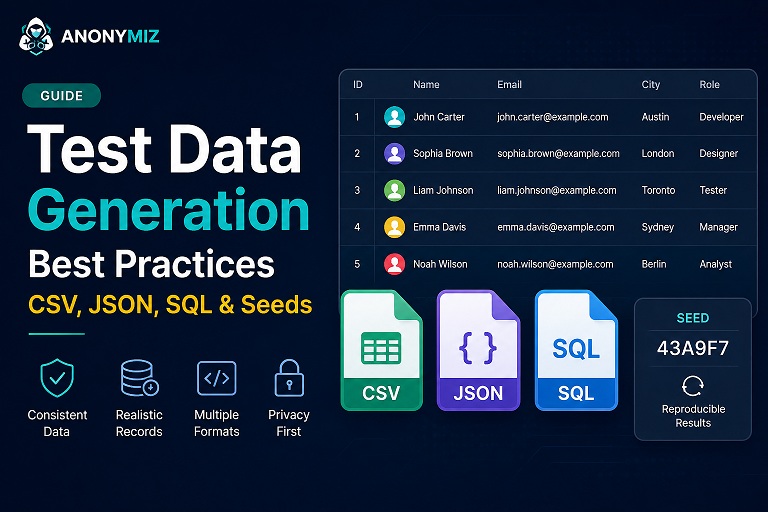
- Use bulk generation and CSV/JSON/SQL export to build a reusable fixture set instead of generating one-off identities by hand
- If your tests need to be reproducible, use a seed value so the same test run produces the same identities every time
Try the Fake Identity Generator directly, or use the full Fake Name & Identity Generator for the same functionality alongside additional country and avatar options.