
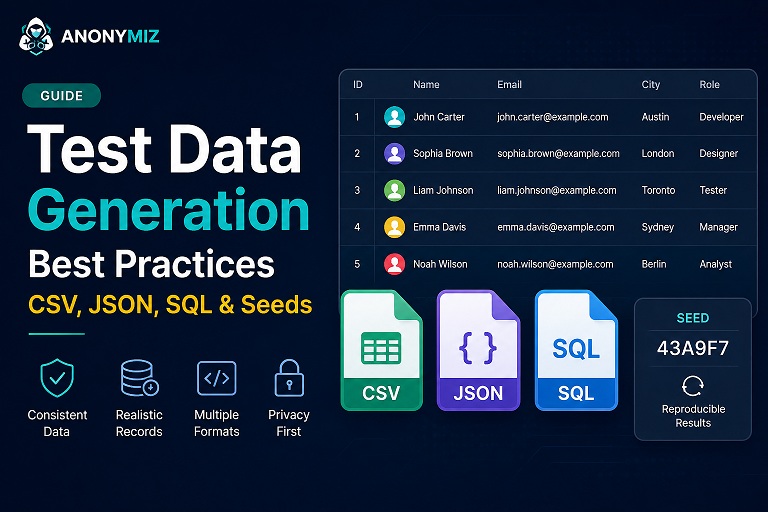
Most test data problems come down to one of three things: it isn't realistic enough to catch real bugs, it isn't in the format your pipeline actually needs, or it's different every time you run your tests, making failures impossible to reproduce. A proper test data generator solves all three.
Realistic data catches more bugs than random strings
Test data built from obviously fake placeholders ("aaaa", "test123") rarely exercises the same code paths as real user input. Correctly-formatted names, emails, phone numbers, and addresses — matching the actual conventions of the countries your product supports — are far more likely to surface formatting bugs, validation edge cases, and locale-specific issues before a real user does.
Exporting in the format your pipeline actually uses
Bulk test data is only useful if it fits directly into your workflow. Depending on what you're building, that usually means one of three formats:
- CSV — for spreadsheet review, or importing into tools that expect tabular data
- JSON — for feeding directly into API tests or JavaScript test fixtures
- SQL — a ready-to-run
CREATE TABLEplusINSERTstatements, for seeding a test database in one step
The Test Data Generator supports all three, generating up to 100 records per batch — enough for most QA fixtures and load-testing scenarios without needing to script your own generator.
Making test failures reproducible with a seed
Randomly-generated test data has one real drawback: when a test fails, the data that caused it is gone by the next run. A seed value fixes this. Enter any text into the Seed field before generating, and that exact seed will always produce the exact same dataset again — useful for CI pipelines where a flaky-looking failure needs to be reproduced locally, or for test fixtures that should stay identical across a whole team. Leave the field blank for a genuinely random dataset, and the tool will show you the seed it used afterward so you can save it and reproduce that same batch later if you ever need to.
A quick checklist
- Generate data that matches your product's real target countries, not just one locale
- Export directly in the format your test suite or database actually consumes
- Use a seed for any test data that needs to be reproducible across runs or across a team
- Regenerate test fixtures periodically rather than reusing the exact same handful of records indefinitely
Try the Test Data Generator directly, or use the full Fake Name & Identity Generator if you also need avatar selection and additional country coverage.