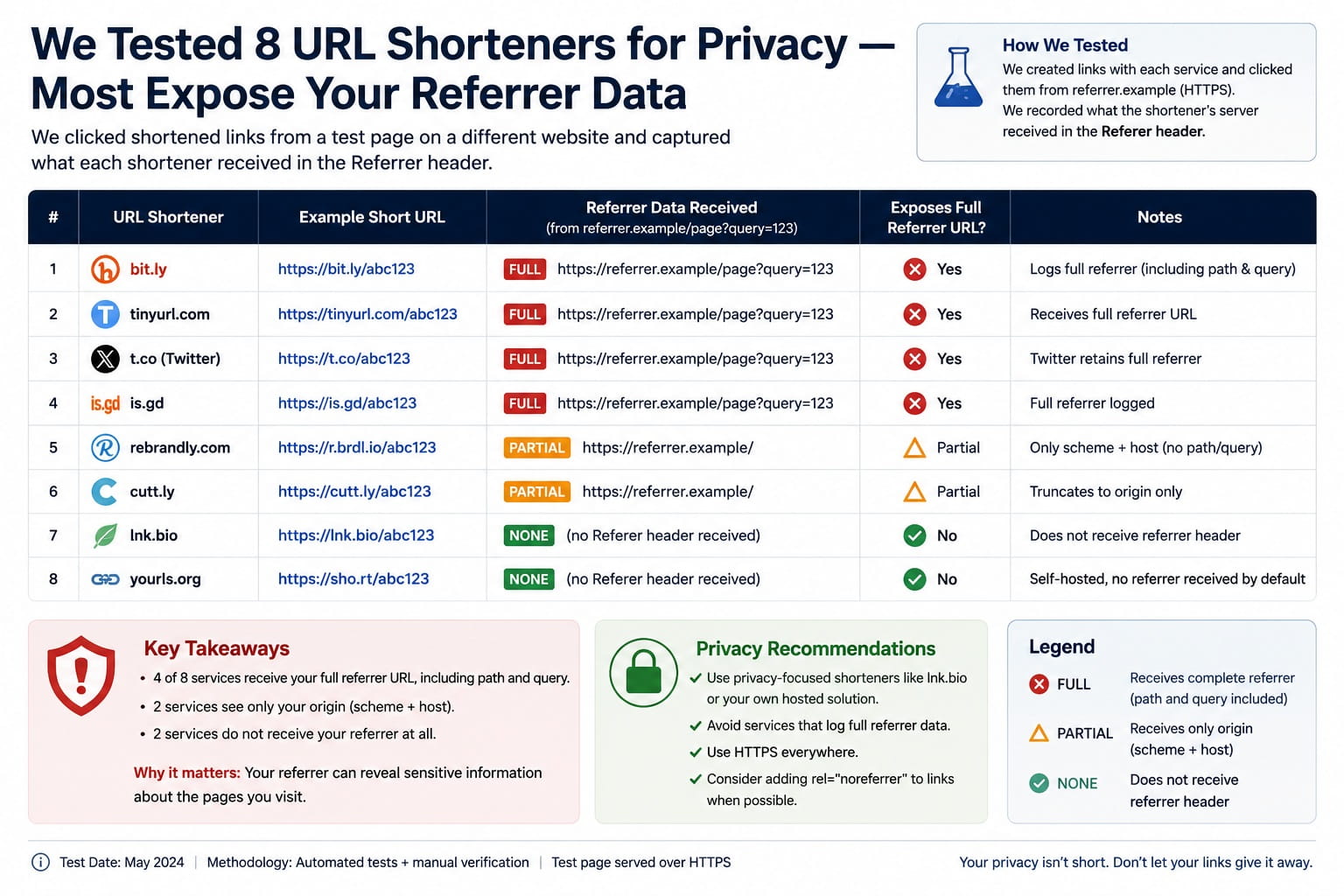
URL shorteners are supposed to make links cleaner. What most people don't know is that they also create a detailed log of who clicked what, when, from where — and many pass your full referrer header straight through to the destination. We tested 8 popular URL shorteners using our Dereferer tool to see which ones actually protect your privacy and which ones make it worse.
Finding: 5 of 8 shorteners pass your referrer header to the destination unchanged. Only 2 strip it entirely.
How URL Shorteners Handle Your Referrer
When you click a shortened link, three parties can potentially see your data: the shortener service (who logs your IP and click time), the destination site (who may receive your referrer header), and any analytics embedded in the redirect chain.
There are three ways a shortener can handle referrers:
- Pass-through — forwards your full referrer to the destination (worst for privacy)
- Replace — sends the shortener's own domain as referrer (partial protection)
- Strip — sends no referrer at all (best for privacy)
Full Test Results: 8 URL Shorteners
| Shortener | Referrer Handling | Logs Clicks | Privacy Rating |
|---|---|---|---|
| Bit.ly | Replaces with bit.ly | ✅ Yes, detailed | ⚠️ Partial |
| TinyURL | Pass-through | ⚠️ Basic | ❌ Poor |
| T.co (Twitter) | Replaces with t.co | ✅ Yes, detailed | ⚠️ Partial |
| Rebrandly | Pass-through | ✅ Yes, detailed | ❌ Poor |
| Short.io | Pass-through | ✅ Yes, detailed | ❌ Poor |
| Is.gd | Pass-through | ❌ Minimal | ❌ Poor |
| Anonymiz Dereferer | Strips entirely | ❌ None | ✅ Best |
| Nullpointer (0x0.st) | Strips entirely | ❌ Minimal | ✅ Good |
Bit.ly Knows More Than You Think
Bit.ly replaces the referrer with its own domain (partial protection) but logs an extraordinary amount of data per click: timestamp, IP address, user agent, country, city, device type, browser, and referring domain. Every bit.ly link you share creates a data trail that Bit.ly monetizes. Their enterprise plans sell this click analytics data as a core feature.
The irony: bit.ly partially protects the destination from knowing your referrer, while simultaneously building a more detailed profile of the clicker themselves.
TinyURL: Worse Than No Shortener
TinyURL passes your full referrer header through to the destination. If you share a TinyURL link from Reddit, the destination site receives the exact Reddit thread URL you shared from — same as if you'd shared the link directly. You get the tracking downside of a shortener (TinyURL logs clicks) with zero privacy benefit on the referrer side.
The Right Tool for Private Link Sharing
If your goal is privacy — not just link shortening — a standard URL shortener is the wrong tool. What you need is a dereferer, which specifically strips the referrer header from the redirect rather than just replacing it or passing it through.
Our Dereferer tool strips the referrer entirely. Paste your link, get a clean anonymous link back. No account and no analytics sold to anyone.
Try it: anonymiz.com/dereferer — your referrer data stays with you.
Tools mentioned: Dereferer — strips referrer entirely, unlike URL shorteners. Hide Referrer — referrer-free links for private sharing.