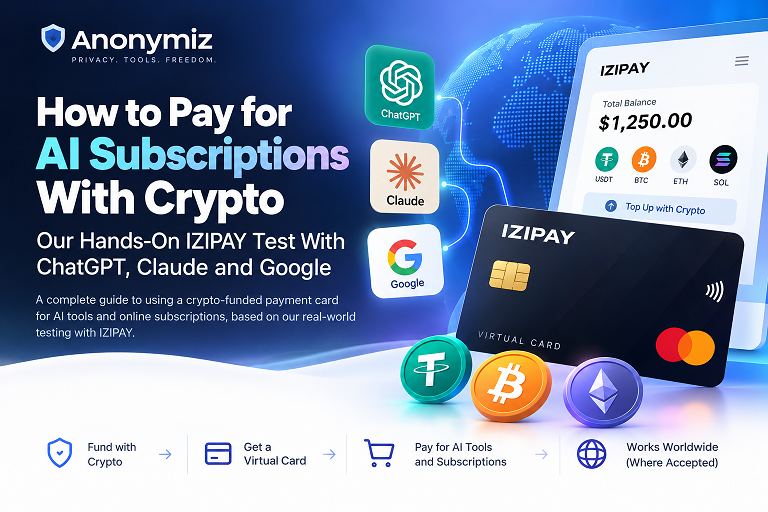
How to Pay for AI Subscriptions With Crypto: Our IZIPAY
A practical guide to using a crypto-funded payment card for ChatGPT, Claude, Google and other online subscriptions, based on our real-world testing.
Anonymiz tested a crypto-funded IZIPAY card with Google-related payments, OpenAI and Claude subscriptions.
Disclosure: IZIPAY provided a demonstration card for testing. Anonymiz independently tested the card using cryptocurrency and successfully completed the transactions described in this article. The test reflects our experience at the time of testing and is not a guarantee of future availability, merchant acceptance, regulatory status or financial performance.
Cryptocurrency is easy to send and receive across borders, but using it to pay for everyday software can still be surprisingly difficult. Many online services accept debit cards, credit cards, Apple Pay or other traditional payment methods while offering no direct cryptocurrency checkout.
That creates an extra step for someone who already holds crypto. They may need to convert their assets to fiat currency, move the money to a traditional financial account and then use a bank card to purchase a subscription. For people who regularly pay for software, cloud services or artificial-intelligence tools, that process can become inconvenient.
A crypto-funded payment card attempts to solve that gap. Instead of asking the merchant to accept cryptocurrency directly, the user funds a card with supported crypto and then uses the card through the merchant's normal card-payment system.
We recently tested this model using an IZIPAY demonstration card. We funded the card with cryptocurrency and used it for several real online payments. Our tests included Google-related payments as well as subscriptions to OpenAI and Claude. The transactions were successful during our testing.
This article explains what we tested, how the payment model works, what the approach means for privacy, how KYC and transaction limits fit into the picture, and what users should consider before putting money into any crypto-funded card.
What Is IZIPAY?
IZIPAY is a payment-card service built around cryptocurrency funding. The basic idea is to let a user add supported digital assets to a card balance and then spend that balance through a virtual or physical payment card.
That creates a bridge between two payment systems. The user starts with cryptocurrency, while the merchant receives a conventional card transaction. In practical terms, the flow looks like this:
Crypto → card funding → virtual or physical card → merchant payment
This model can be useful when the service being purchased does not have a native crypto payment option. Instead of waiting for every merchant to integrate Bitcoin, stablecoins or another cryptocurrency, the card handles the payment at the card-network level.
For users, the important question is not simply whether a card exists. It is whether the card can be used at the services they actually need. That is why our hands-on test focused on real subscriptions and online payments rather than only checking whether the IZIPAY dashboard worked.
Why Use a Crypto-Funded Card for AI Subscriptions?
AI subscriptions are a good example of the problem. Tools such as ChatGPT and Claude are used by developers, writers, researchers, students, businesses and everyday users. Their paid plans can become recurring monthly expenses.
For a cryptocurrency holder, there are two separate questions: how to obtain the subscription and how to pay for it. If the merchant does not directly accept crypto, the second question becomes the difficult one.
A crypto-funded card can reduce the number of steps between the user's crypto wallet and the online checkout. The user can fund the card first and then use the card number in the same way they would use another payment card.
There can also be a practical privacy benefit in separating a subscription payment from a user's primary bank card. That does not mean the transaction becomes anonymous, but it can reduce the number of websites and merchants that receive the user's primary card details.
Our Hands-On IZIPAY Test
We did not evaluate IZIPAY solely from its marketing material. We were provided with a demonstration card and used it ourselves.
First, we funded the card using cryptocurrency. We then used the resulting card details for real online transactions. The card worked for Google-related payments and also successfully processed subscriptions to OpenAI and Claude during our test.
What we successfully tested:
- Cryptocurrency funding of the card
- Google-related payment/recharge
- OpenAI subscription payment
- Claude subscription payment
- General online card-payment functionality
This matters because a payment card can look convincing on a website while still failing at the merchant checkout. Our experience showed that the card was functional for the specific services and transactions we tested.
There is an important limitation: one successful transaction does not prove that a card will work at every merchant, in every country, forever. Payment processors can change their rules, merchants can restrict card types, and recurring-payment systems can behave differently from one-time payments.
How to Pay for ChatGPT With Crypto
OpenAI subscriptions normally use conventional payment methods rather than a cryptocurrency checkout. A crypto-funded card can provide another route: fund the card with crypto and then use the card at the normal subscription checkout.
IZIPAY provides a dedicated explanation of this process in its guide to paying for ChatGPT with crypto.
The general workflow is:
- Create or access an eligible IZIPAY account.
- Create or activate the relevant virtual card.
- Fund the card with a supported cryptocurrency.
- Open the normal OpenAI subscription checkout.
- Enter the virtual card details as the payment method.
- Complete the payment and confirm the subscription.
We tested this approach ourselves. The IZIPAY card successfully processed an OpenAI subscription payment during our testing.
The practical advantage is that the user does not need the AI service itself to implement a cryptocurrency checkout. The card functions as the payment bridge.
How to Pay for Claude With Crypto
Claude presents a similar situation. Users may want to fund an AI subscription from cryptocurrency, while the normal checkout expects a supported card payment method.
IZIPAY has a dedicated guide to paying for Claude with crypto that explains its approach.
The process is broadly the same as with OpenAI:
- Set up an eligible crypto-funded card.
- Add supported cryptocurrency to the card.
- Open Claude's normal subscription checkout.
- Enter the virtual card information.
- Complete the subscription payment.
We also tested the card with a Claude subscription and the payment was successful at the time of our test.
For developers and AI-heavy users who maintain a significant portion of their spending assets in cryptocurrency, this can be a convenient way to pay for recurring software without first moving the funds through a traditional card account.
What About Google Payments?
Our testing also included a Google-related payment/recharge, and the card worked successfully for that transaction.
This is useful because it demonstrates a broader use case beyond AI subscriptions. A crypto-funded card can potentially be useful anywhere the relevant card network, merchant and payment processor accept the card and transaction.
However, users should not interpret one successful Google transaction as a universal compatibility guarantee. Google has multiple products, billing systems and regional payment configurations. Acceptance can depend on the exact service, account country and transaction type.
What Cryptocurrencies Can Be Used?
IZIPAY advertises support for multiple cryptocurrencies and networks. Examples include USDT, USDC, Bitcoin, Ethereum and Solana, among others.
Stablecoins can be particularly convenient for predictable subscription spending because their intended value is closer to a fiat currency than highly volatile assets such as Bitcoin or Ether. That said, users should always verify the exact supported token and network before sending funds.
Crypto transfers are also different from card payments: sending an asset to the wrong address or incompatible network can result in a loss that may not be reversible. Users should therefore confirm the deposit network and asset before every transfer.
How Does the No-KYC Model Work?
One of the reasons crypto-funded cards attract attention from privacy-conscious users is the possibility of using a standard tier without immediately submitting traditional identity documents.
IZIPAY describes standard usage without document-based KYC, subject to applicable limits and compliance controls. The important point is that “no KYC for standard usage” should not be interpreted as “no compliance requirements.”
Financial and payment services can use transaction limits, risk checks, anti-money-laundering controls and additional verification when appropriate. A user who reaches a higher limit or triggers a compliance review may be asked to provide additional information.
For this reason, anyone considering a crypto-funded card for significant balances should read the provider's current terms and KYC/AML documentation before depositing money.
What About the $1,500 Unverified Limit?
IZIPAY has described a standard unverified tier with a limit of up to $1,500. Users should verify the current limit shown in their account and the provider's current documentation because limits and eligibility rules can change.
It is also important not to confuse a standard-tier limit with the maximum transaction or spending limits that may apply to a fully verified card. Different limits can apply to funding, card payments, monthly volume and account verification levels.
For an article about privacy, this distinction is important. A limited no-document tier is not the same thing as an unrestricted anonymous financial account.
Is an IZIPAY Card Anonymous?
The word “anonymous” needs to be handled carefully when discussing payment products.
A crypto-funded card may reduce exposure of a user's primary bank-card details to an online merchant. However, that does not automatically make the underlying payment anonymous.
There can be records at several layers: the cryptocurrency transaction itself can be visible on a public blockchain, the card provider can have account and transaction records, the card network and processor can process payment information, and the merchant can retain information about the purchase.
For privacy-conscious users, it is more accurate to describe the benefit as payment separation or reduced exposure of primary card credentials rather than promising complete anonymity.
Fees and Costs to Consider
Price is one of the first things to compare before choosing any crypto-funded card.
Provider fees can include card issuance, cryptocurrency top-ups, conversion spreads, network costs, foreign-exchange costs or other transaction charges. Fees can also change over time, so users should check the current pricing page before funding a card.
Even when a card has no traditional monthly maintenance fee, the total cost of using it can still be higher than a normal bank card because of crypto conversion or top-up charges.
For a single low-value subscription, the cost of obtaining and funding a card may not make sense. For someone who regularly pays for several digital services using cryptocurrency, the convenience may justify the cost.
Does a Crypto Card Work With Every Subscription?
No payment card should be assumed to work with every merchant.
Acceptance can depend on the card network, merchant category, country, billing address, payment processor, recurring-payment rules and the merchant's policies regarding prepaid or virtual cards.
Our IZIPAY test was successful with the services we specifically tested, including Google-related payments, OpenAI and Claude. That is useful evidence of compatibility, but it should not be presented as a guarantee for every subscription.
Who Might Benefit From a Crypto-Funded Card?
This type of payment method may be particularly interesting for cryptocurrency holders who regularly pay for digital services.
- AI users: People paying for ChatGPT, Claude and other AI tools.
- Developers: Users paying for software, APIs, cloud services and development platforms.
- Crypto-native users: People who keep a significant part of their spending balance in cryptocurrency.
- Privacy-conscious users: People who prefer not to provide their primary bank-card details to every online subscription.
- International users: People who encounter payment-method or regional-card limitations.
It may be less useful for someone who already has a conventional card that works everywhere they need and who does not regularly hold or spend cryptocurrency.
Security Considerations Before Funding a Crypto Card
Crypto transactions are generally irreversible, so users should treat card funding with the same care they would use when sending assets to any external service.
Before sending a significant amount, verify the destination address, network and asset. Start with a small amount if you are unfamiliar with the provider. Keep account credentials secure and enable available security protections.
Users should also understand who is responsible for card issuance, payment processing, custody or crypto conversion. A website can provide the user interface while different third-party companies perform underlying financial functions.
That distinction matters when assessing the risk of a payment service. A successful payment proves that the system worked for that transaction; it does not remove the need to understand the provider's terms, counterparties and policies.
Our Overall Experience With IZIPAY
Our hands-on experience was positive. The most meaningful part of the test was that we did not stop at account creation or a simulated payment.
We funded the demonstration card with cryptocurrency and used it for real transactions. Google-related payment/recharge worked, and we successfully used the card for both OpenAI and Claude subscriptions.
That makes the service more interesting than a theoretical crypto-payment product. It demonstrated that the crypto-funded-card model can work in practical online subscription scenarios.
At the same time, our test should be understood as a snapshot of real-world compatibility rather than a guarantee. Merchant policies, card programs, regional rules and payment processors can change.
Final Thoughts
Paying for AI subscriptions with cryptocurrency has traditionally required an extra conversion step because many AI services still rely on conventional card payments.
A crypto-funded virtual card provides a simple bridge: fund the card with supported cryptocurrency and use the card at the merchant's normal checkout.
Our testing of IZIPAY showed that this approach can work in real-world scenarios. We successfully funded the card with cryptocurrency and used it for Google-related payments, an OpenAI subscription and a Claude subscription.
For cryptocurrency users who regularly pay for AI tools and other online services, this can be a useful payment option. Privacy-conscious users should nevertheless distinguish between payment separation and complete anonymity, while all users should review current fees, limits, supported countries, compliance requirements and provider terms before depositing funds.
The strongest reason to consider a service like this is not a marketing promise. It is whether the payment workflow works for the services you actually use. In our testing, it did.
Frequently Asked Questions
Can I pay for ChatGPT with cryptocurrency?
A crypto-funded payment card can be used as the card payment method for an OpenAI subscription where the card is accepted. We tested an IZIPAY card with an OpenAI subscription and the payment was successful during our testing.
Can I pay for Claude with cryptocurrency?
A crypto-funded virtual card can be used as a payment method for Claude where the card is accepted. We tested an IZIPAY card with a Claude subscription and the payment was successful during our testing.
Can I use IZIPAY without completing KYC?
IZIPAY offers a standard usage level that can be accessed without submitting traditional identity documents, subject to applicable limits and compliance controls. Additional verification may be required in some circumstances.
What cryptocurrencies can I use to fund an IZIPAY card?
IZIPAY advertises support for multiple cryptocurrencies and networks, including assets such as USDT, USDC, Bitcoin, Ethereum and Solana. Supported assets can change, so check current provider information before depositing.
Does IZIPAY work with online subscriptions?
It can. During our testing, an IZIPAY card was successfully used for Google-related payments and subscriptions to OpenAI and Claude. Acceptance can vary by merchant, country, card type and payment processor.
Is an IZIPAY card anonymous?
It is more accurate to describe a crypto-funded card as providing separation from a primary bank card rather than assuming transactions are completely anonymous. Providers, merchants and blockchain networks may process transaction information.
How do I pay for an AI subscription using crypto?
Create or activate a supported crypto-funded card, fund it with cryptocurrency, then use the virtual card details at the AI service's normal subscription checkout.
Is a crypto-funded card safe to use?
Users should evaluate the provider's terms, fees, limits, supported countries, compliance requirements and card/payment partners before depositing funds. A successful test does not guarantee future availability or acceptance.
Useful Links
IZIPAY homepage · Pay for ChatGPT with crypto · Pay for Claude with crypto