Affiliate marketing depends on tracking. Every click from your content to a merchant needs to be attributed to your affiliate account. But raw affiliate URLs are long, ugly, and transparent — revealing your affiliate program, commission structure, and marketing strategy to anyone who hovers over your links.
Affiliate link cloaking solves all of this. This complete guide explains what it is, how it works technically, what the legal requirements are, how Amazon specifically handles it, and what tools and strategies actually generate more clicks.
What Is Affiliate Link Cloaking?
Link cloaking replaces a long tracking URL with a shorter, cleaner URL on your own domain that redirects to the original affiliate link when clicked. The tracking parameters that attribute the commission are preserved — the affiliate network still receives correct attribution — but the URL in your content is professional and readable.
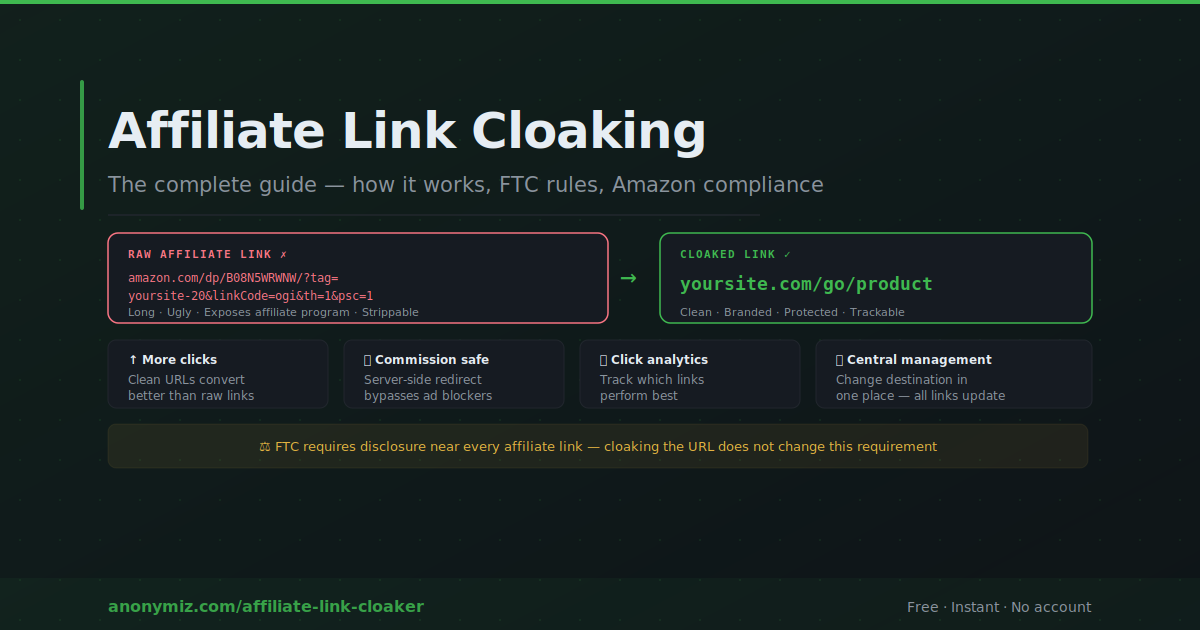
Raw Amazon link: https://www.amazon.com/dp/B08N5WRWNW/?tag=yoursite-20&linkCode=ogi&th=1&psc=1
Cloaked version: yoursite.com/go/product-name
When a visitor clicks the cloaked link they are redirected to the original affiliate URL with all tracking parameters intact. Commission preserved. URL professional.
Why Affiliate Marketers Cloak Links
Better click-through rates
Clean readable URLs get more clicks than 200-character tracking strings. Visitors hover over links — if the preview shows a wall of parameters, many hesitate or avoid clicking. A clean yoursite.com/go/product URL looks trustworthy and intentional.
Commission protection
Some browser extensions strip affiliate tracking parameters before the user reaches the merchant. A server-side redirect happens before the user's browser can modify the URL, protecting your parameters from being stripped by client-side extensions.
Competitor intelligence protection
Raw links reveal which affiliate programs you are in and which products you promote. Cloaked links look like internal paths on your domain — competitors analysing your site cannot immediately identify your monetisation strategy.
Centralised management
When a merchant changes their URL format or you switch affiliate networks, you update the redirect destination in one place and every instance of that cloaked link automatically points to the new destination. Essential for large sites with thousands of affiliate links.
Click analytics
Cloaking tools include click tracking — showing which links get the most clicks, which pages drive affiliate traffic, and which products your audience is most interested in.
How It Works Technically
Cloaking is a URL redirect. When a visitor clicks a cloaked link, their browser requests the cloaked URL from your server. Your server looks up the destination and returns an HTTP redirect — either 301 (permanent) or 302 (temporary) — pointing to the affiliate URL. The visitor's browser follows the redirect automatically, arriving at the merchant's page with tracking parameters intact.
Most affiliate marketers use 302 temporary redirects: it signals to search engines that canonical content is at the destination, avoids passing PageRank through affiliate links, and prevents the redirect being aggressively cached in ways that cause attribution problems if you change the destination.
Cloaking Methods
WordPress plugins: ThirstyAffiliates and Pretty Links are the dominant choices — link cloaking, click tracking, geolocation redirects, keyword auto-linking. Most popular for WordPress affiliate sites.
Simple redirect tools: The Anonymiz Affiliate Link Cloaker creates clean redirect links instantly — no account, no setup. Useful for one-off links or testing.
Server-side redirects: Direct .htaccess or PHP redirects for developers. Maximum control, zero overhead: Redirect 302 /go/product https://merchant.com/?affiliate=yourcode
FTC Disclosure Requirements
The Federal Trade Commission requires clear disclosure of affiliate relationships near affiliate links regardless of whether the link is cloaked. Cloaking the URL does not change this requirement. Disclosures must be clear and conspicuous — placed near the relevant link or content, not buried in a general disclaimer or footer-only disclosure page. The standard compliant approach is a brief note near the top of content containing affiliate links: "This post contains affiliate links — I may earn a commission at no extra cost to you."
Amazon Associates and Cloaking
Amazon prohibits certain types of link modification that prevent Amazon from properly attributing the referral. Standard 302 redirects that pass through tracking correctly are generally acceptable. URL shorteners that Amazon cannot verify and cloaking that obscures attribution from Amazon's systems are prohibited. When in doubt use ThirstyAffiliates which has been specifically tested for Amazon compliance, or check the Associates Programme Operating Agreement.
SEO Implications
Add rel="nofollow" or rel="sponsored" attributes to affiliate links — Google recommends this to prevent passing PageRank to merchant sites. Use 302 redirects, not 301, for affiliate links. Consider adding noindex to your /go/ redirect directory to prevent search engines crawling and potentially indexing redirect pages on very large affiliate sites.
Frequently Asked Questions
Does affiliate link cloaking hurt SEO?
When done correctly with 302 redirects and nofollow attributes it is SEO-neutral. Google handles redirect chains. The SEO risk comes from using 301 redirects which can pass link equity to merchants, or not using nofollow attributes which can appear to Google as paid links without proper disclosure.
Is link cloaking the same as link shortening?
Similar but different. URL shorteners use third-party domains — your cloaked link points to bit.ly, not your domain. This loses branding benefit and means you depend on a third-party service. Affiliate link cloaking uses your own domain, giving you full control and consistent branding.
Can affiliate networks detect cloaked links?
Yes. Networks track conversions through cookies set when users arrive at the merchant's site via an affiliate link. The cookie is set based on the affiliate parameter in the URL — which is preserved through the redirect. The network can see which affiliate parameter triggered the cookie.