
What is a YTS Proxy? A Deep Dive into YIFY Access in 2026
In the vast ecosystem of online entertainment, YTS (formerly known as YIFY) remains an undisputed giant for high-quality, compact movie torrents. However, its immense popularity has made it a prime target for global censorship and ISP throttling. This is where the YTS proxy comes into play. But what exactly is it, and how does it work under the hood?
This comprehensive guide will unravel the technical and practical aspects of YTS proxies. By the end, you will understand not just how to use them, but the underlying architecture that makes them necessary and effective in 2026.
Understanding the Core: The Proxy Concept
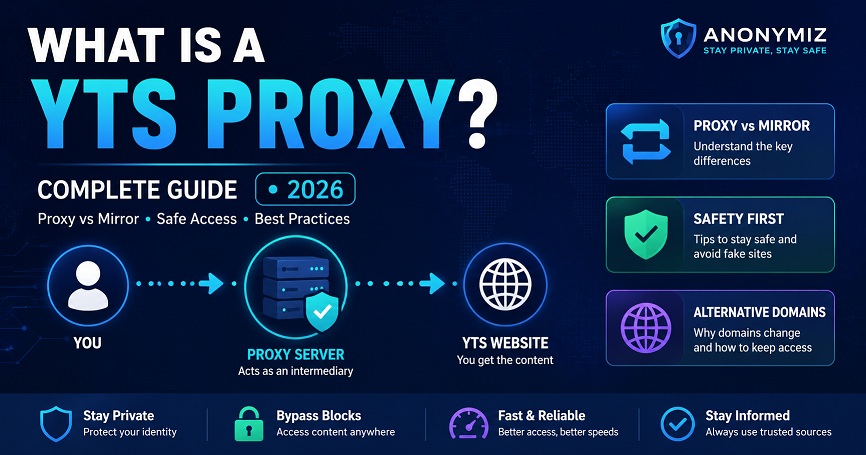
Before we dive specifically into YTS, we must define a proxy server. In networking, a proxy acts as a gateway or intermediary between a user's device and the internet. Instead of connecting directly to a website, your device connects to the proxy, and the proxy connects to the website. The website sees the proxy's IP address, not yours.
When applied to YTS, a proxy allows you to access the YTS domain even if your local Internet Service Provider (ISP) has blocked the main URL. The proxy effectively "scrubs" or reroutes your digital footprint, allowing you to view the torrent index as if the block never existed.
Forward Proxy vs. Reverse Proxy for YTS
Most users think of a "forward proxy" (the kind you set up in your browser settings). However, the proxies you find on sites like our updated YTS proxy list are actually Reverse Proxies. Here is the distinction:
- Forward Proxy: You configure your browser to route traffic through a specific server. This is useful for general privacy but doesn't usually mask the fact that you are visiting YTS specifically.
- Reverse Proxy: This sits directly in front of the YTS web server (or a cached copy of it). When you visit the proxy URL, it fetches data from the original YTS source, formats it, and serves it to you. These are the ".is", ".mx", or ".to" domains you often see listed.
Essentially, when you click a reverse proxy link, you are visiting an exact replica or gateway of YTS. The website looks identical, but the backend server is different, making it harder for authorities to take it down permanently.
| Feature | Forward Proxy (Browser Config) | Reverse Proxy (YTS Mirrors) |
|---|---|---|
| Setup Complexity | High (requires manual config) | Low (just click a link) |
| Speed | Varies (depends on proxy location) | Usually fast (cached assets) |
| Anonymity | High (hides all web traffic) | Medium (only hides YTS traffic) |
| Maintenance | User-controlled | Proxy owner-controlled |
Why Do We Need YTS Proxies in 2026?
The cat-and-mouse game between copyright enforcement agencies and torrent sites is relentless. Here are the primary reasons YTS proxies are currently thriving:
1. ISP-Level Censorship
In countries like the United Kingdom, Australia, India, and much of Europe, courts have ordered ISPs to block access to YTS domains. When you type yts.mx into your browser, your ISP's DNS server returns a dead IP or redirects you to a legal warning page. Proxies utilize domain names that aren't yet on the blacklist, effectively side-stepping these court orders.
2. Domain Seizures
Historically, the US Department of Homeland Security has seized YTS domains (such as .ag and .is). The official YTS team has to continuously migrate to new top-level domains (TLDs). Proxies often spring up faster than the official migration, acting as a bridge for users trying to find the new home of YTS.
3. Privacy Concerns
Even if YTS is accessible in your country, you might not want your ISP logging your torrent browsing history. Using a proxy adds a layer of separation between your IP and the YTS servers, providing a basic shield against data logging and personalized advertising based on your viewing habits.
The Technical Handshake: How a YTS Proxy Works
Let's break down the journey your browser takes when you access a YTS proxy:
- DNS Request: You type the proxy URL (e.g.,
yts-proxy-xyz.com). Your computer asks a DNS server for the IP address of this domain. Since the domain is new, it resolves correctly. - TCP Connection: Your browser establishes a TCP connection to the proxy server's IP address on port 443 (HTTPS).
- SSL/TLS Handshake: A secure SSL certificate is exchanged. (This is why you should only use HTTPS proxies; it encrypts the data you send and receive).
- Request Forwarding: The proxy receives your request for the YTS homepage. It then makes its own request to the official (or upstream) YTS database.
- Data Caching & Response: The proxy grabs the HTML, torrent files, and images. It may cache these assets. It then sends the perfectly formatted YTS page back to your browser.
This process happens in milliseconds. For a deeper technical comparison between this architecture and simple mirrors, check out our article on YTS Proxy vs Mirror.
Is Every YTS Proxy Safe? A Cautionary Tale
While proxies are incredibly useful, they are also a double-edged sword. Since anyone can set up a proxy, malicious actors often create fake YTS proxies to steal credentials or inject malware. Here are safety indicators to look for:
- SSL Certificate Validity: Ensure the padlock in your browser is green/valid.
- Domain Age: Very new domains (created last week) should be approached with caution.
- Ad Density: Ad-heavy mirrors are common, but if pop-ups are forcing downloads or asking for credit card details, leave immediately.
Always stick to verified sources. We maintain a live-updated list of safe YTS proxies to help you avoid these security pitfalls.
Frequently Asked Questions
Can I use a YTS proxy on my mobile phone?
Absolutely. YTS proxies are web-based, meaning they run in your mobile browser (Chrome, Safari, Firefox). Just open the proxy URL, and the mobile-optimized version of YTS will load automatically.
Will a proxy speed up my YTS downloads?
No. A proxy only affects the browsing experience (finding torrents). The download speed of the actual .torrent file or magnet link depends on the number of seeders and your internet bandwidth, not the proxy.
How often does the YTS proxy list change?
Virtually every week. Due to aggressive court orders, proxies go down daily. We update our official list multiple times per week to ensure only working links remain.
Conclusion
A YTS proxy is more than just a workaround; it is a testament to the resilience of decentralized access in the face of censorship. By understanding the mechanics—the reverse proxy architecture, DNS resolution, and HTTPS encryption—you can navigate the YTS ecosystem safely and efficiently. As we move further into 2026, the game of whack-a-mole will continue, but proxies remain the most accessible tool for the average user.
For the most reliable, up-to-date, and secure YTS proxy links, be sure to bookmark our YTS Proxy List.
Related Reading: Why is YTS Blocked? (A Legal Deep Dive) | How to Identify Fake YTS Sites