
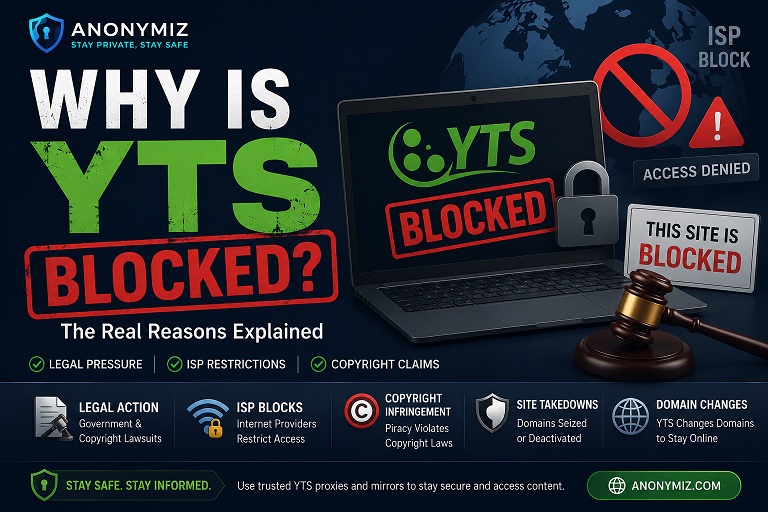
Why is YTS Blocked? Unraveling the Global Crackdown on YIFY
Every few months, YTS users panic as the familiar domain goes dark. The URL stops resolving, and a government seizure banner appears in its place. But why is YTS blocked specifically, and why are the blocks so aggressive compared to other sites?
This article explores the multi-billion dollar legal machinery behind the blocks, the specific legislation used, and the geopolitical chess game that keeps YTS in the crosshairs.
The Copyright Conundrum
At its core, YTS (YIFY) is known for distributing high-quality, compressed movie torrents. The site does not host the movie files themselves, but rather the metadata and torrent files that allow peer-to-peer sharing. However, copyright law in the US and EU holds that facilitating access to copyrighted works constitutes contributory infringement.
The Motion Picture Association (MPA) acts as the primary enforcer. They track down domain registrars, web hosts, and payment processors associated with YTS, threatening legal action unless the services are terminated. Because YTS operates with minimal infrastructure, it relies on third-party services, which often buckle under legal pressure.
How ISPs Implement the Block
ISPs don't manually block sites; they follow court orders. Here are the primary technical methods they use:
- DNS Poisoning: Your ISP's DNS server returns an incorrect IP address (often a localhost IP or a police warning page).
- IP Blacklisting: The ISP simply drops packets heading to the specific IP address associated with the YTS domain.
- Deep Packet Inspection (DPI): Advanced ISPs analyze the data packets themselves. If they see HTTP host headers matching YTS, they block the connection. This is why HTTPS (SSL) is crucial.
To circumvent these blocks, users turn to solutions like proxies. Our updated YTS proxy list helps bypass these exact technical barriers.
| Country | Blocking Method | Legislation Used |
|---|---|---|
| United Kingdom | DNS & IP Blocking | Digital Economy Act |
| Australia | DNS Filtering (Court Ordered) | Copyright Amendment Act |
| India | ISP Blocking Orders | IT Act (2000) |
| Germany | High Court Injunctions | Urheberrechtsgesetz (UrhG) |
The Domain Seizure Playbook
In 2015, the YTS website operated on the `.ag` (Antigua) domain. It was seized by US Immigration and Customs Enforcement (ICE). They don't physically possess the domain; they coordinate with the registry to change the DNS nameservers. When you visit the domain now, you see the infamous "Seized by the US Government" banner.
This pattern repeated for .is, .to, and .lt domains. The constant seizures force YTS to migrate to "rogue" TLDs like .cam or .guru, which are harder for US authorities to control but generally have lower trust scores with search engines.
For a complete timeline of domain migrations, read our companion post on the History of YTS Domains.
Is It Just Legal Pressure?
Not entirely. There are significant financial pressures too. The MPA frequently files lawsuits against domain registrars like Namecheap or GoDaddy, forcing them to suspend domains without a court order (under threat of massive litigation costs). Consequently, YTS has to use obscure registrars that are less compliant with US subpoenas, which often leads to the site going offline unexpectedly for days while they hunt for a new registrar.
Frequently Asked Questions
Is using a proxy to access YTS illegal?
Bypassing ISP blocks is generally not illegal for the user, as it is seen as a privacy measure. However, the act of downloading copyrighted content remains illegal regardless of how you access it.
Are there countries where YTS isn't blocked?
Yes. Many countries with less stringent copyright enforcement or no bilateral agreements with the MPA do not block YTS. However, these are becoming fewer as international trade agreements push for global anti-piracy standards.
Conclusion
The blocking of YTS is a high-stakes legal war funded by the multi-billion dollar movie industry. It utilizes every tool—from legislative lobbying to technical DPI—to make YTS inaccessible. However, as the battle rages on, users are left in the crossfire. Staying informed about working proxies is the only practical way to continue accessing the content you love while the legal debate rages on.