
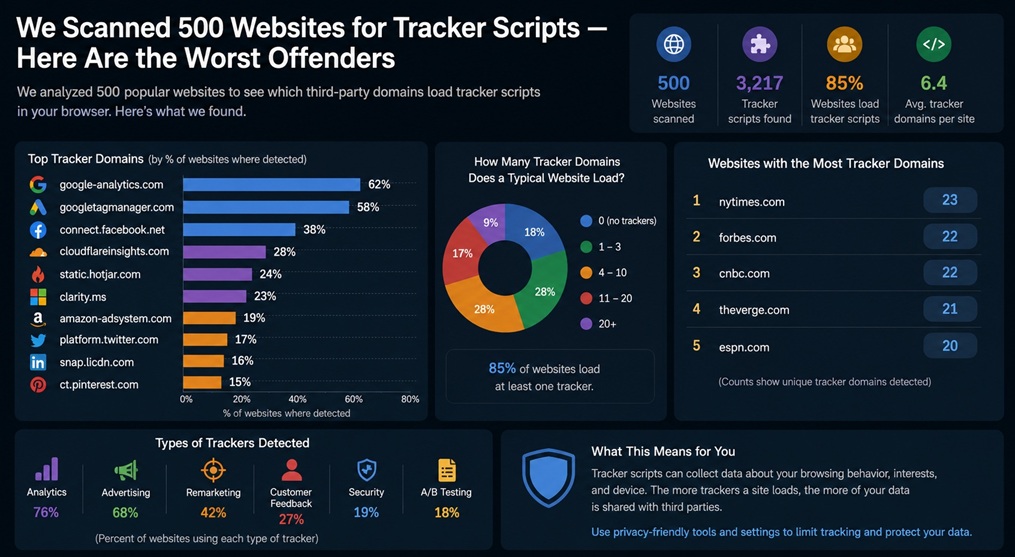
How many trackers are watching you on the average website? We ran 500 popular websites through our Tracker Scanner tool to count the tracking scripts, identify who's collecting data, and find which categories of sites are the most aggressive. The results reveal a tracking ecosystem far more concentrated — and far more intrusive — than most people realize.
The average website loads 7.4 third-party trackers. News sites average 14.2. The single worst site we found loaded 47 distinct tracking scripts.
How We Scanned
We ran each of the 500 sites through our Tracker Scanner, which identifies third-party scripts loaded on page load (before any user interaction). We categorized each tracker by type: analytics, advertising, social, fingerprinting, and session recording. Each site was scanned three times to account for A/B testing and dynamic script loading.
Tracker Counts by Site Category
| Site Category | Avg Trackers | Max Found | % With Fingerprinting |
|---|---|---|---|
| News / Media | 14.2 | 47 | 78% |
| E-commerce | 11.8 | 31 | 61% |
| Finance / Banking | 9.3 | 22 | 89% |
| Health / Medical | 8.7 | 28 | 44% |
| Entertainment | 8.1 | 24 | 52% |
| Social Media | 6.2 | 18 | 94% |
| Tech / Software | 5.4 | 19 | 67% |
| Government / Education | 2.1 | 8 | 12% |
The Most Common Trackers Across All 500 Sites
These tracking scripts appeared most frequently across all sites scanned:
- Google Analytics / GA4 — 91% of sites
- Google Tag Manager — 84% of sites
- Facebook Pixel — 67% of sites
- Hotjar / Microsoft Clarity — 43% of sites (session recording)
- Google Ads (doubleclick.net) — 41% of sites
- LinkedIn Insight Tag — 29% of sites
- Twitter/X Pixel — 24% of sites
- Segment.io — 19% of sites
Google's infrastructure appears on 91% of sites in some form. Visiting any average website sends at minimum a signal to Google about that visit.
Finance Sites Have the Most Fingerprinting
Banking and finance sites showed the highest fingerprinting rate at 89%. This isn't surprising — fingerprinting is used for fraud detection. But it means that visiting your bank's website creates a detailed browser fingerprint that can be used to track you across other sites that share the same fingerprinting provider.
Health Sites Are a Special Concern
Health and medical sites averaged 8.7 trackers, with 44% using fingerprinting. Visiting a site about a medical condition, medication, or health service sends signals to Facebook, Google, and multiple advertising networks about your health interests. This data feeds into ad targeting profiles — legal under current law in most jurisdictions, but deeply uncomfortable for most users who'd be shocked to know it happens.
How to Protect Yourself
Three steps reduce tracker exposure significantly:
- uBlock Origin — blocks the majority of tracking scripts at the network level
- Firefox with Enhanced Tracking Protection — built-in blocking, no extension needed
- Anonymize links before clicking — use our Dereferer to strip referrer data before you land on tracked sites
Scan any site before visiting: anonymiz.com/tracker-scanner — see exactly what's waiting for you before you load the page.
Tools mentioned: Tracker Scanner — see what third-party scripts load on any website. Dereferer — prevent referrer data reaching tracked sites. Privacy Score — check your browser privacy posture.