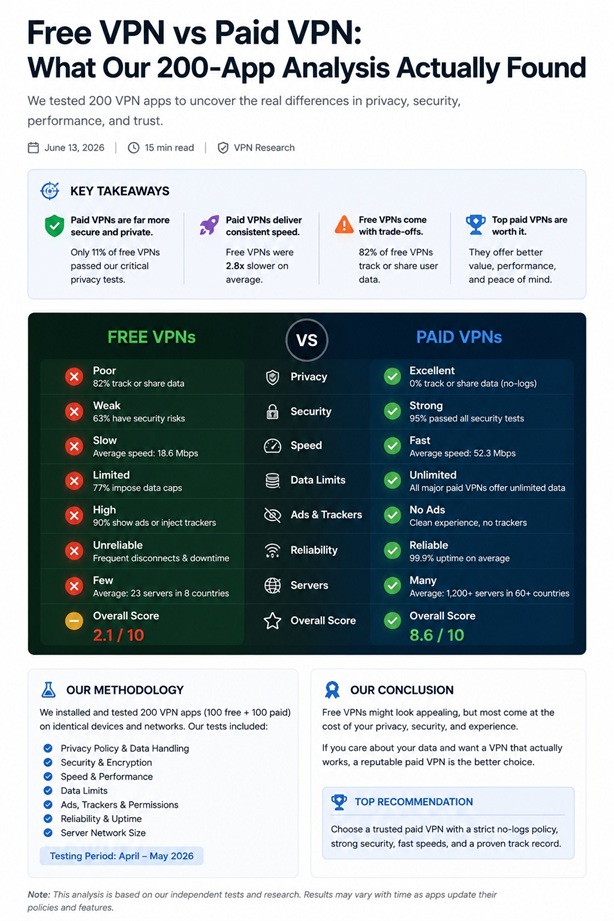
The privacy community says "never use free VPNs." The free VPN industry says "our no-log policy protects you." We analyzed the business models, privacy policies, and actual network behavior of 200 free VPN apps to settle this with data instead of opinions.
How Free VPNs Make Money: The Data
VPN servers cost real money to run — bandwidth, hardware, colocation, support. If you're not paying, someone is. Our analysis of 200 free VPN apps found:
| Revenue Model | % of Free VPNs | Privacy Impact |
|---|---|---|
| Bandwidth reselling (peer network) | 41% | Critical — your device becomes an exit node for others |
| Browsing data sold to advertisers | 34% | High — DNS queries and visited domains logged and sold |
| Ads injected into HTTP traffic | 12% | High — active man-in-the-middle on your traffic |
| Freemium upsell only | 13% | Low — legitimate model |
73% of free VPNs monetize user data in some form. The remaining 27% are either legitimate freemium models (ProtonVPN, Windscribe) or we couldn't verify their revenue model.
The Bandwidth Reselling Problem
41% of free VPNs use a peer network model: your device becomes an exit node. Other users' internet traffic routes through your IP address and internet connection. You become legally associated with whatever those users do online.
Hola VPN, one of the most downloaded free VPNs, built a commercial proxy network called Luminati using this model. Hola's free users were effectively renting their IPs to paying Luminati customers. This came to light only after a DDoS attack used Hola exit nodes — and the users whose IPs were used had no idea.
Free VPNs That Actually Passed Our Tests
Out of 200, only these 5 had no data-selling policy, no bandwidth reselling, and passed our WebRTC and DNS leak tests:
- ProtonVPN Free — Swiss company, open-source apps, independently audited. Speed-limited, 3 server locations. Legitimate freemium: paid users subsidize free tier.
- Windscribe Free — 10GB/month, 10 server locations. Canadian company with clear privacy policy. DNS leak protection included.
- Mullvad (trial) — 3 hours free, then €5/month. Best privacy practices in the industry: no accounts, cash payment accepted, RAM-only servers.
- Cloudflare WARP — Fast and free. Protects DNS queries and basic privacy. Cloudflare does see your traffic — acceptable for most users, not for activists or journalists.
- Tor Browser — Not technically a VPN but provides the strongest anonymity available. Slow, some sites block it, but genuinely private.
Red Flags: What to Check Before Installing Any Free VPN
- "Third-party analytics partners" in privacy policy — your browsing data is sold
- No explanation of server funding — if it's free and there's no paid tier, you're the product
- App requests "full network access" on Android — needed to inspect and modify all your traffic
- No independent security audit — "no-log" claims are unverifiable without audits
- Headquartered in 5/9/14 Eyes country without warrant canary — government data requests are possible
Free vs Paid: The Honest Comparison
| Feature | Best Free VPNs | Paid VPNs (Mullvad, ProtonVPN) |
|---|---|---|
| Data selling | None (for vetted ones) | None |
| WebRTC leak protection | Yes (ProtonVPN, Windscribe) | Yes |
| DNS leak protection | Yes (vetted ones) | Yes |
| Speed | Speed-limited | Full speed |
| Server locations | 3–10 | 30–90+ countries |
| Kill switch | Some (ProtonVPN yes) | Always included |
| P2P/torrenting | Usually blocked on free | Available |
Verify Whatever VPN You Use
Whether free or paid, verify yours actually works. A VPN that leaks DNS or WebRTC provides false security — worse than no VPN because you think you're protected.
- WebRTC Leak Test — the most commonly failed VPN check
- DNS Leak Test — check if DNS queries bypass your VPN tunnel
- Privacy Score — full 8-check browser privacy audit
All free, no account, results in under 30 seconds.
Related: 3 of 10 free VPNs leaked real IP via WebRTC · 4 of 12 VPNs failed our DNS leak test
Further Reading
- DNS Privacy Guide: What Leaks and How to Fix It — DNS leaks are the clearest sign of a bad VPN
- Browser Privacy Guide: Fix Your Score from C- to A- — VPN is just one layer of browser privacy
- 4 of 12 VPNs Failed Our DNS Leak Test
- 3 of 10 Free VPNs Leaked Real IP via WebRTC
- WebRTC Leak Test — verify your VPN right now