There are dozens of AI content detectors and most of them measure the same underlying signals. What actually differs between them is free-tier limits, input length, whether you get sentence-level detail or just a score, and how honest they are about uncertainty. This comparison covers five widely used options and where each one fits.
A note on what this is not: no independent, reproducible accuracy benchmark exists for these tools that covers current models across edited and unedited text. Any article giving you precise accuracy percentages is either citing a vendor's own marketing or inventing numbers. What follows compares features and suitability, which is verifiable.
What Makes a Good AI Detector?
Four things matter more than a headline accuracy claim:
Transparency about limitations
A tool that returns "98% AI" with no caveats is overselling. Detection is probabilistic, and the useful tools say so. This matters practically: if you are going to act on a result, you need to know how much weight it can carry.
Minimum input length
All statistical detection needs volume. Tools that accept a single sentence and still return a confident score are giving you noise dressed as a result. Look for stated minimums around 150–300 words.
Sentence-level breakdown
A single document score is far less useful than highlighting which passages look generated. Most real-world documents are mixed — drafted by a model, partly rewritten — and only per-passage detail shows you that.
Privacy handling
You are pasting someone's writing into a third-party service, sometimes a student's work or an unpublished draft. Whether the text is stored, logged or used for training is a real consideration and often buried in the terms.
Comparison at a Glance
| Tool | Free tier | Sentence detail | Signup required | Best for |
|---|---|---|---|---|
| Anonymiz AI Content Detector | Unlimited | Signal breakdown | No | Quick checks, seeing the reasoning |
| GPTZero | Word-capped | Yes | For higher limits | Mixed documents |
| ZeroGPT | Generous | Yes | No | Longer documents |
| Copyleaks | Trial only | Yes | Yes | Institutional use |
| Originality.ai | None (paid) | Yes | Yes | Publishers, agencies |
1. Anonymiz AI Content Detector
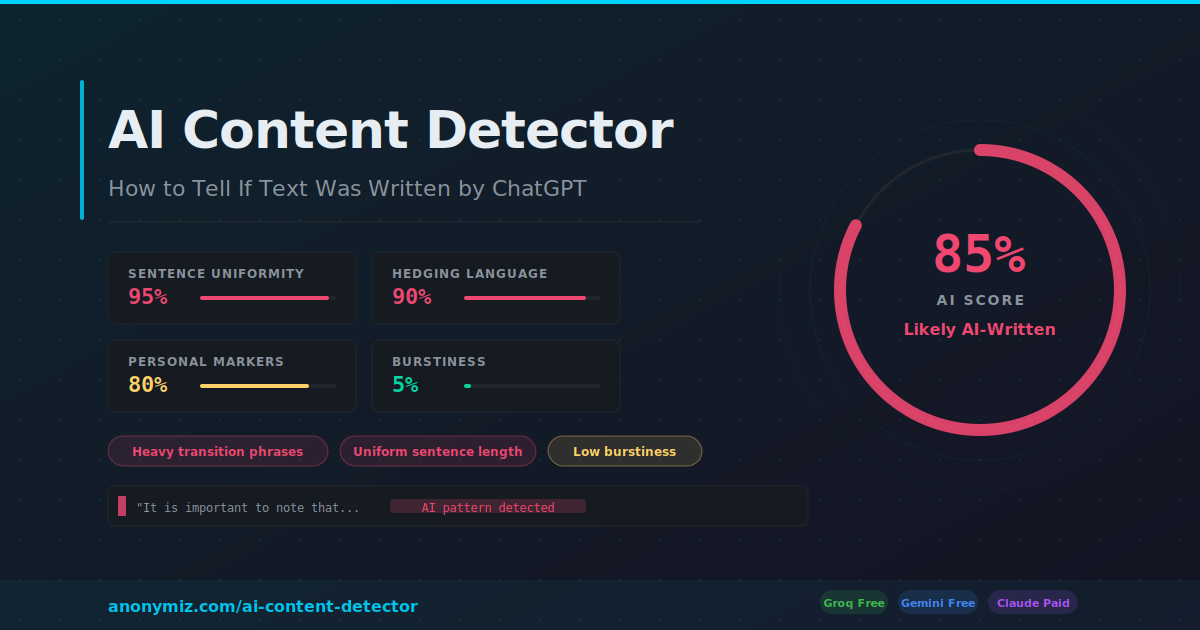
Our own AI Content Detector analyses perplexity and sentence-length variation and returns a confidence score alongside the specific signals behind it, rather than a bare verdict. No signup, no word cap, and pasted text is not stored.
Best for: quick checks where you want to understand why a passage was flagged. Limitation: like all detectors, unreliable below roughly 200 words, and edited text will pass.
2. GPTZero
One of the earliest dedicated detectors and still among the most established. Its main strength is sentence-level highlighting, which makes it genuinely useful for mixed documents where only sections were generated.
Best for: documents you suspect are partly generated. Limitation: the free tier caps words per check, and heavier use pushes you toward a paid plan.
3. ZeroGPT
A no-signup option with a relatively generous free allowance, which makes it convenient for longer documents when you do not want to create an account.
Best for: longer text, casual use. Limitation: less transparent than others about methodology, and worth treating its confidence figures with the same scepticism you would apply to any single tool.
4. Copyleaks AI Detector
Aimed at education and enterprise, with LMS integrations and multi-language support. Positioned for institutions rather than individuals.
Best for: organisations that need detection inside an existing workflow. Limitation: not meaningfully free — the trial is limited and real use requires a subscription.
5. Originality.ai
Paid only, built for publishers and content agencies, and it combines AI detection with plagiarism checking in one pass.
Best for: teams commissioning writing at volume who need both checks together. Limitation: no free tier at all, so it is only worth it if you are checking regularly.
Which Should You Use?
Occasional checks, no account: our detector or ZeroGPT. Mixed documents where you need to see which parts are flagged: GPTZero. Academic work: our AI Essay Detector is tuned specifically for that register. Short business emails: the AI Email Detector, since general tools struggle most on short text. Institutional deployment: Copyleaks. Publishing at volume: Originality.ai.
A practical suggestion: run important text through two tools rather than one. Agreement between independent detectors is meaningfully stronger evidence than a high score from a single one, and disagreement tells you the result is not solid enough to act on.
A Note on Accuracy
Every tool above shares the same limitations, and they matter more than the differences between them.
False positives are unevenly distributed. Formal, well-structured writing gets flagged more often, and non-native English speakers are affected disproportionately because writing learned through formal instruction tends toward the regular structures detectors treat as suspicious. Any process that penalises people on a detector score will produce unfair outcomes at a predictable rate, concentrated on the same groups.
Editing defeats detection. Varying sentence lengths and replacing predictable phrasing moves most text below thresholds, which means a low score does not establish human authorship. And no detector can identify which model produced a text, despite occasional claims otherwise.
Use these tools to inform a judgement, not to make one. Where the stakes are high, drafts and version history establish authorship in a way statistics cannot.
Frequently Asked Questions
Which free AI detector is most accurate?
There is no reliable public benchmark that would let anyone answer this honestly across current models and edited text. Tools that publish precise accuracy figures are generally citing their own testing. Running two independent detectors and comparing is more informative than trusting any single claim.
Do free detectors work as well as paid ones?
They measure the same underlying signals. Paid tools mainly add volume, integrations, reporting and plagiarism checking rather than fundamentally better detection. For occasional individual use, free tools are generally sufficient.
Can I use a detector result as proof?
No. Detectors report statistical likelihood, not authorship, and their errors fall disproportionately on certain groups of writers. Treat a result as a prompt to ask questions, never as a finding on its own.
Why do two detectors give me different answers?
They weight signals differently and were calibrated on different data. Disagreement is common on borderline text and is itself useful information — it means the passage is not clearly one thing or the other.
How long does the text need to be?
At least 200–300 words for a meaningful reading. Below roughly 150 words there is not enough signal, regardless of how confident a tool appears.
Related Reading
To spot generated text without a tool, see our guide to the signs that text was written by AI. For checking whether a website was built with AI rather than its text, use the AI Website Detector.