AI-generated text is everywhere — in blog posts, emails, essays, product descriptions and marketing copy. Most of it is grammatically fine, which is exactly why it slips past. The tells are not errors; they are patterns of over-regularity that become obvious once you know what to look for.
The reason is structural. A language model predicts the most probable next word, over and over. That produces prose which is fluent, safe and slightly generic — and consistent in ways human writing rarely is. Below are seven signs, roughly in order of reliability, followed by the ones that mislead people.
1. Hedging Phrases Used Constantly
Models soften claims by default. Watch for stacked qualifiers that add length without adding meaning: "it's important to note that," "generally speaking," "in many cases," "it's worth considering," "can often be seen as."
Humans hedge too, but selectively — usually when they are genuinely uncertain about that specific claim. The AI tell is hedging applied evenly across everything, including statements nobody would dispute. When a paragraph qualifies both a contested claim and an obvious one with equal caution, that uniformity is the signal.
2. Transition Words Everywhere
"Furthermore," "Moreover," "Additionally," "In conclusion," "It's worth noting." Models use connectives to signal structure because that structure was rewarded in training.
Human writers usually let ideas flow without announcing each turn, reserving explicit transitions for genuine pivots in argument. If nearly every paragraph opens with a connective, and the connectives are interchangeable — you could swap "Furthermore" for "Moreover" with no loss — the text is likely generated.
3. Perfectly Uniform Sentence Length
Read a paragraph aloud. Do all the sentences run roughly the same length, with similar clause structure?
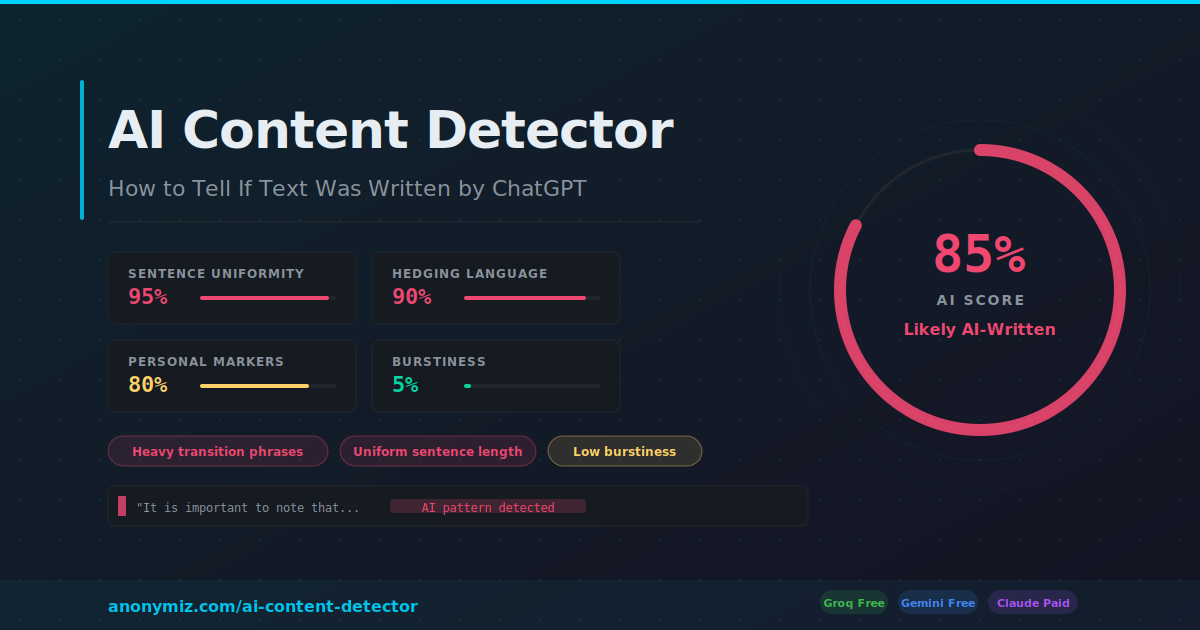
Human writing has rhythm. A long, winding sentence that accumulates qualifications and subordinate clauses is followed by a short one. Like this. Models trained for fluency drift toward a comfortable 15–25 word range and stay there. This is the property detection tools call burstiness, and it is the most measurable sign on the list — which is also why it is the first thing to disappear once someone edits the text.
4. No Personal Anecdotes or Specific Details
This is the strongest tell, and the hardest to fake convincingly.
A model has no lived experience to draw on. It produces "many businesses have found that customer retention improves" where a human writes "we lost three clients in Q2 before we figured out the onboarding email was going to spam." The generated version is a category; the human version is an incident, with numbers, names and a specific mechanism.
Scan for concrete nouns and specific figures. Generated text gravitates toward the general case because the general case is what was most probable in training. When specifics do appear, they are often round, plausible-sounding and unverifiable — "studies show a 40% increase" with no study named.
5. Characteristic Vocabulary
Certain words became strongly associated with model output after 2022: "delve," "tapestry," "realm," "landscape," "navigate" (used metaphorically), "leverage," "robust," "seamless," "underscore," "pivotal."
Treat this as weak evidence on its own. These are all legitimate English words, and plenty of human writers use them — particularly in business and academic registers where they are conventional. A single "delve" means nothing. Three or four of these clustered in one short passage, alongside other signs, means more.
6. Balanced Lists of Exactly Three Things
Models have a marked preference for the rule of three. Three benefits, three considerations, three steps — and the items are usually parallel in grammatical structure and similar in length.
Real lists are lumpier. Some have two items because there are only two; some have seven; some mix a one-word entry with a long explanatory one because the subject matter demands it. Suspiciously tidy triads throughout a document suggest the structure came from a model rather than from the material.
7. No Real Opinions
Generated text presents multiple perspectives and declines to commit. "There are advantages and disadvantages to both approaches, and the right choice depends on your specific circumstances."
That sentence is technically true and completely useless. Models are trained toward balance and away from strong positions. A human expert writing about their own field usually does have a view, states it, and gives reasons — often dismissing an option outright. The absence of any position at all across a long piece is telling.
Signs That Mislead People
A few things get treated as evidence but are not:
Em dashes and semicolons
These are widely claimed as AI tells. They are simply punctuation that some writers use heavily and others avoid. Plenty of careful human writers use em dashes constantly. On its own this indicates nothing.
Perfect grammar
Good editors produce error-free prose. Spelling and grammar checkers have been standard for decades. Cleanliness is not evidence of generation.
Formal or corporate tone
Business writing sounded like business writing long before language models existed. Formality reflects register and audience, not authorship.
The text "feeling off"
Intuition here is unreliable in both directions. Research consistently finds people perform close to chance at distinguishing AI from human text without tools. If you want to calibrate your own judgement, try our AI vs Human Quiz — most people score worse than they expect.
How to Weigh the Signs Together
No single item on this list is conclusive. What matters is accumulation: uniform sentence rhythm plus no specific details plus hedging throughout plus no stated position is a meaningfully different picture from any one of those alone.
Two important limits. First, length matters — these patterns need a few hundred words to assess, and a single paragraph rarely provides enough signal. Second, editing removes most of them. Someone who varies sentence lengths and adds a genuine anecdote can defeat every sign here, which means the absence of tells is not evidence of human authorship.
For a statistical second opinion, our AI Content Detector measures the same underlying patterns and returns a confidence score with the reasoning behind it. For academic work specifically, the AI Essay Detector is tuned for that register, and the AI Email Detector handles shorter business correspondence.
Frequently Asked Questions
Is there one definitive sign of AI writing?
No. The closest is the absence of specific, verifiable detail drawn from experience — but a writer who adds real anecdotes to generated text defeats it. Reliability comes from several signs appearing together, not from any single one.
Can I trust my instinct about whether text is AI?
Not much. Studies repeatedly show people perform near chance without assistance, and confidence does not correlate well with accuracy. Knowing the specific patterns above helps; a general feeling that something is "off" does not.
Does using AI to help write mean the text is AI-written?
That depends on the standard being applied, and it is worth being clear about which one matters to you. Text drafted by a model and substantially rewritten by a person is different from text pasted unchanged, though most detection tools will not distinguish them well.
Why does AI use words like "delve" so often?
These words appear at elevated rates in the text models were trained on, particularly formal and academic writing, and reinforcement from human feedback favoured a polished register. The result is a vocabulary that skews toward the slightly elevated word over the plain one.
Do these signs work for languages other than English?
The general principles — uniformity, absent specifics, no committed position — carry across languages. The specific vocabulary tells do not, since they come from English-language training patterns. Detection tools are also markedly less accurate outside English.