Why We Built a Free Link Anonymizer (And What 12 Million Users Taught Us About Privacy)
We've never told this story publicly. But after 12 million anonymized links and three years building Anonymiz, it feels like the right time.
The Problem That Started It
We were sharing a link in a private conversation — the kind of conversation you'd assume was between just the two of you. The link pointed to a medical information site. After clicking, the site's analytics showed not just that someone visited, but exactly where they came from: which forum, which thread title, everything.
That wasn't a data breach. That was the web working exactly as designed.
Every link click sends a Referer HTTP header to the destination. It's automatic, invisible, and built into every browser since 1995. The destination website sees: where you came from (exact URL), what you were reading, and when. Combined with your IP address and browser fingerprint, a single click creates a surprisingly complete picture of who you are and what you're interested in.
We built Anonymiz because this felt wrong — and fixable.
How It Works
The concept is simple: instead of your browser going directly from Source → Destination, it goes Source → Anonymiz redirect → Destination. Our server strips the referrer header before forwarding. The destination sees the click came from our anonymizer, not from where you actually were.
The technical implementation is a clean PHP redirect with the Referrer-Policy: no-referrer header set on the intermediate page. What matters to users: paste a link, get a clean link back, share it anywhere. No account. Free.
What 12 Million Anonymizations Actually Looks Like
We didn't expect Anonymiz to reach 12 million links. We expected a few hundred privacy enthusiasts. What we found instead were entirely different groups of people using the tool in ways we hadn't imagined:
Corporate Employees — Our Fastest Growing Segment
Usage from corporate network ranges grew 340% in 2025. The pattern is clear in the data: lunch hour spikes, clusters from specific company IP blocks, links shared in internal Slack and Teams conversations.
The reason is simple: corporate networks log everything. When you click a link in a company Slack message, your IT department's proxy can see the referrer — what channel it came from, what you were discussing. Employees aren't hiding anything illicit. They're reclaiming basic browsing privacy from surveillance infrastructure that was never explained to them when they joined.
Privacy Researchers
Security researchers use Anonymiz to probe suspicious sites without announcing themselves. If you're investigating a phishing operation and visit their site from your research organization's IP, the operators know they're being watched. Through an anonymizer, the investigation stays covert until you're ready to act.
Several researchers have told us this is their first step in any site investigation — anonymize the link, then visit. Standard operating procedure that we inadvertently built tooling for.
Journalists Covering Sensitive Stories
A journalist investigating a company for corruption visits that company's website. Without anonymization, the company's analytics show: a visitor from a newsroom IP, coming from a search for "[Company Name] financial irregularities." They know someone is looking.
Anonymized: they see an anonymous visit from our IP, no referrer. The investigation doesn't tip off the subject.
What We've Never Done
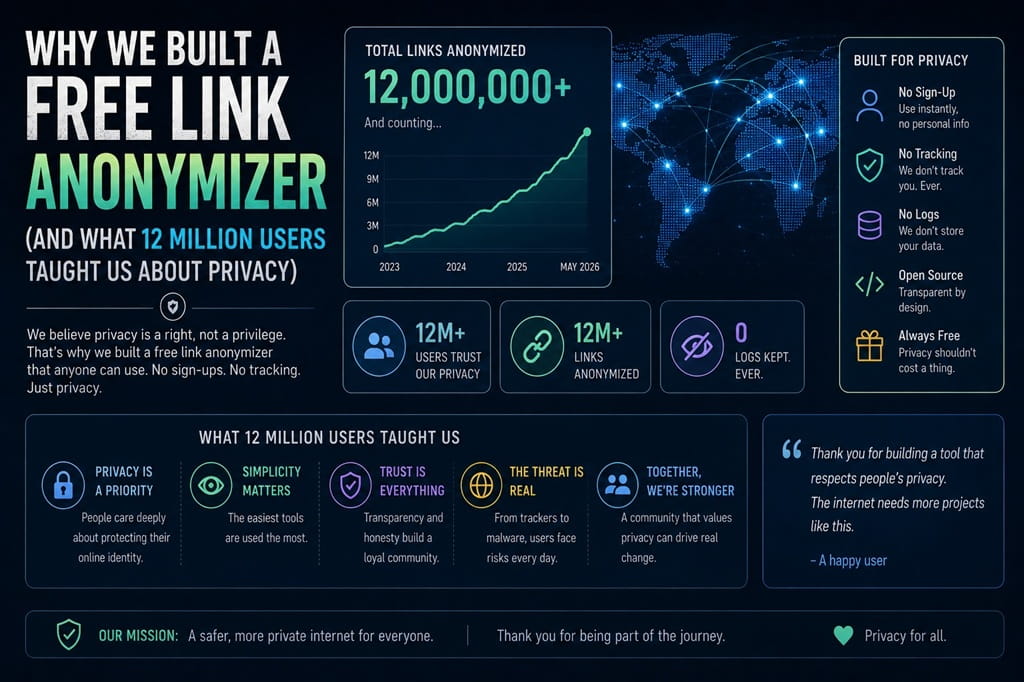
We've never sold user data. We've never run ads. We've never required an account. We've never stored logs of which links were anonymized or by whom.
This isn't a legal technicality. We literally have no database of user activity to sell or subpoena. The architecture makes retention impossible by design: the redirect happens in real-time with no write operations to persistent storage.
Privacy tools that log your activity to sell you better privacy products are not privacy tools. We built the opposite.
The Numbers Right Now
- 12 million+ links anonymized
- 0 logs stored
- 0 accounts required
- 100% free, forever
- 100+ free privacy and security tools available
What's Next
We're continuing to build tools around the same philosophy: privacy should require no expertise, no subscription, and no trust in our good intentions. The tools should be designed so that trusting us is optional — which means building systems where we structurally can't betray that trust even if we wanted to.
The Privacy Score tool we recently launched does this for browser privacy. Our WebRTC Leak Test does it for VPN verification. Every tool we add follows the same logic: tell people exactly what's being exposed and give them a way to fix it.
Privacy shouldn't be a premium feature.
Try the dereferer: anonymiz.com/dereferer — no signup, no account, no catch.
Tools mentioned: Dereferer — the original Anonymiz tool, strips referrer headers. Privacy Score — 8 browser privacy checks. WebRTC Leak Test — verify your VPN is not leaking.