
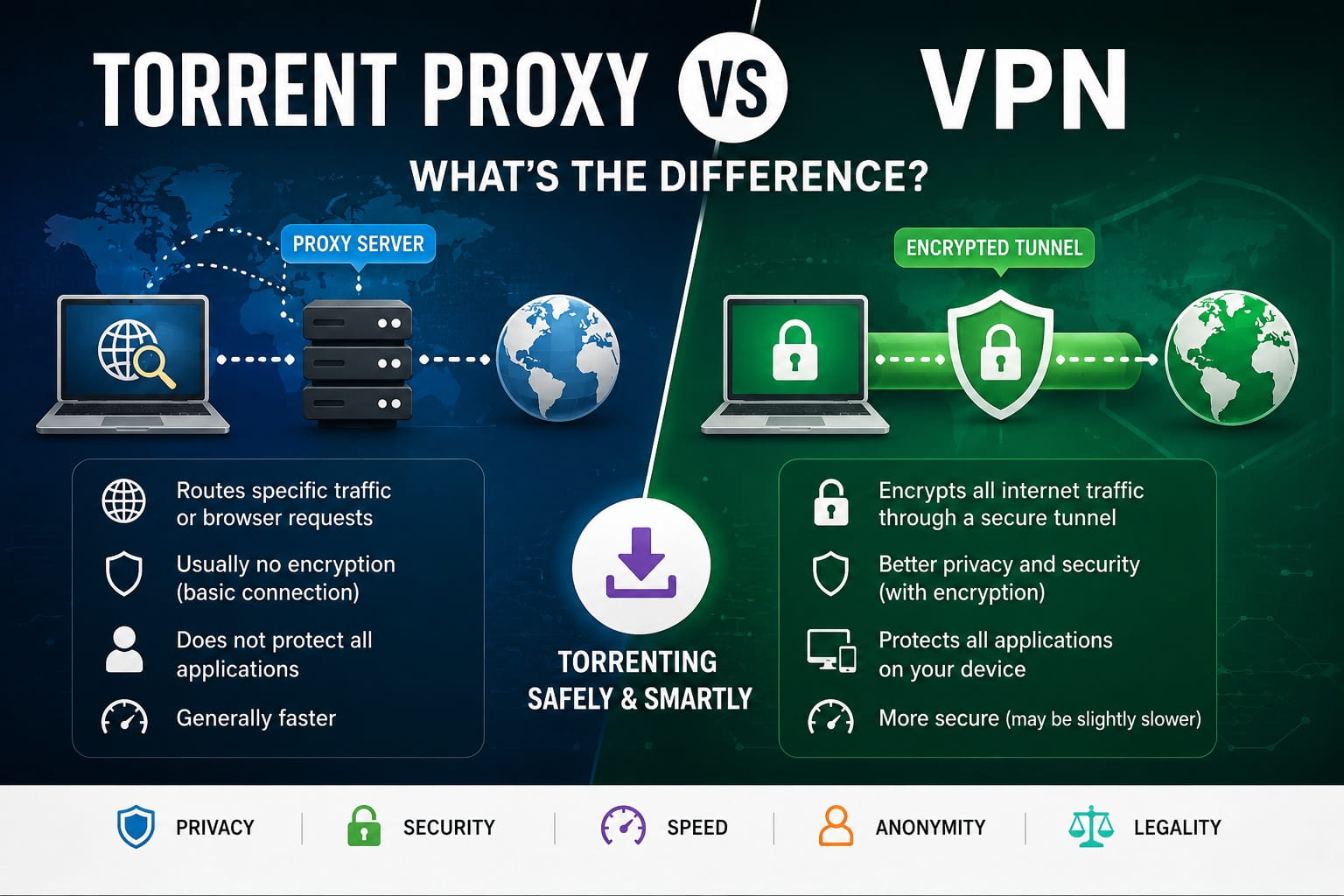
Torrent Proxy vs VPN: What's the Difference?
Torrent proxies and VPNs are often discussed together because both can route internet traffic differently. However, they are not the same technology, and they do not provide identical privacy, security, or network behavior.
Some people assume that using any proxy automatically provides the same protection as a VPN. Others believe that every VPN works exactly like a proxy. Both assumptions are inaccurate.
A torrent proxy and a VPN both route internet traffic differently, but they are not the same. A proxy usually forwards specific connections or browser requests, while a VPN creates an encrypted tunnel for a much broader range of internet traffic. Their privacy, security, performance, and limitations differ depending on how each service is configured.
This guide explains the differences between torrent proxies and VPNs, how each technology works, their advantages and limitations, and common misconceptions.
| Torrent Proxy | VPN |
|---|---|
| Routes selected traffic | Routes most device traffic |
| Usually no encryption | Encrypted tunnel |
| Often browser/app specific | Device-wide protection |
| Usually faster | May be slightly slower due to encryption |
What Is a Torrent Proxy?
A torrent proxy is an intermediary server that forwards specific internet connections between a user and another service.
Depending on the type of proxy, it may forward:
- Browser traffic
- Specific application traffic
- SOCKS connections
- HTTP requests
- HTTPS requests
Instead of connecting directly, the request first passes through the proxy server. If you want the full mechanics, see how Pirate Bay proxies work.
A simplified connection looks like:
You → Proxy → Destination
The destination website or service communicates with the proxy server rather than directly with the user.
For browser-based examples, read our guide explaining how Pirate Bay proxies work.
What Is a VPN?
A VPN (Virtual Private Network) creates an encrypted connection between a user's device and a VPN server.
Instead of forwarding only selected browser requests, a VPN typically routes a much broader range of internet traffic through its encrypted tunnel.
A simplified connection is:
You → Encrypted VPN Tunnel → VPN Server → Internet
The VPN server then communicates with websites and online services.
Proxy vs VPN at a Glance
| Feature | Proxy | VPN |
|---|---|---|
| Encrypts connection | Usually not | Usually yes |
| Routes browser traffic | Yes | Yes |
| Routes application traffic | Depends on configuration | Usually yes |
| Device-wide protection | Usually no | Usually yes |
| Uses encrypted tunnel | Usually no | Yes |
| Changes visible IP to destination | Often yes | Usually yes |
| Can improve privacy | Depends on configuration | Depends on provider and configuration |
| Browser configuration required | Often yes | Usually handled by VPN software |
How Does a Torrent Proxy Work?
When using a proxy, the request may follow these steps:
- Browser or application sends a request.
- The proxy receives it.
- The proxy contacts the destination.
- The destination returns the response.
- The proxy forwards the response.
Example:
Visitor
↓
Proxy
↓
Website
↓
Proxy
↓
Visitor
The proxy acts as the middle layer.
How Does a VPN Work?
A VPN works differently.
Instead of forwarding only selected requests, the VPN software usually creates an encrypted tunnel between the device and the VPN server.
Everything inside that tunnel is encrypted before leaving the device.
The VPN server then forwards requests to websites.
Example:
Device
↓
Encrypted Tunnel
↓
VPN Server
↓
Website
↓
VPN Server
↓
Encrypted Tunnel
↓
Device
What Gets Encrypted?
This is one of the biggest differences.
A VPN normally encrypts traffic travelling between the device and the VPN server.
A browser proxy may simply forward requests.
Whether encryption exists depends on:
- HTTPS
- Proxy configuration
- Application support
- Protocol being used
HTTPS protects browser connections separately from whether a proxy is used.
Which Is Faster?
There is no universal answer.
Performance depends on:
- Server quality
- Distance
- Traffic load
- Network congestion
- Encryption overhead
- ISP routing
- Hardware
A proxy may have less processing overhead because it may not encrypt all traffic.
A VPN may introduce additional processing because of encryption.
However, a well-managed VPN may outperform an overloaded proxy.
Which Provides Better Privacy?
Privacy depends on how the service operates.
A proxy operator may receive:
- IP address
- Requested pages
- Browser information
- Connection timestamps
A VPN provider may also receive certain connection information depending on how the service is configured.
Neither technology should automatically be assumed to provide complete anonymity.
Always review privacy policies carefully.
Does a Proxy Hide Your IP Address?
A proxy may present its own IP address to the destination website.
However, the proxy itself generally receives the visitor's original connection.
Depending on configuration, additional information may also be forwarded.
This means using a proxy does not automatically make browsing anonymous.
Does a VPN Hide Your IP Address?
A VPN generally presents the VPN server's IP address to the destination website.
However, this does not automatically mean complete anonymity.
Privacy depends on:
- VPN configuration
- Logging practices
- Network setup
- Local laws
- Account information
- Browser behaviour
Can Both Work with Torrent Applications?
Some proxy technologies can be configured for specific applications such as torrent clients.
Similarly, many VPN services can route application traffic through the VPN tunnel.
Exactly how traffic is handled depends on the software and configuration being used.
Browser-based Pirate Bay proxies are different—they generally affect browser requests rather than automatically changing how a separate torrent application connects.
Learn more in our guide to how Pirate Bay proxies work.
Are Browser Proxies the Same as Torrent Proxies?
No.
A browser proxy normally affects browser traffic.
A torrent client may use different network settings.
A browser proxy usually does not automatically route traffic from a separate application.
This distinction is often misunderstood.
What About SOCKS5 Proxies?
SOCKS5 is a proxy protocol capable of forwarding different types of network traffic.
Unlike a traditional HTTP proxy, SOCKS5 can work with a wider variety of applications.
However, SOCKS5 itself should not automatically be assumed to provide encryption.
Encryption depends on how the connection is implemented.
VPN vs Proxy for Browser Privacy
For browser use:
Proxy may:
- Forward browser requests
- Rewrite pages
- Change visible IP to websites
VPN may:
- Encrypt device-to-server traffic
- Protect more applications
- Route more network traffic
Neither technology should replace good browser security practices.
Common Myths
Myth 1: A Proxy and a VPN Are the Same Thing
A proxy and VPN are identical.
They are different technologies with different purposes.
Myth 2: Every Proxy Encrypts Your Traffic
Every proxy encrypts traffic.
Many proxies simply forward requests.
Myth 3: Every VPN Guarantees Anonymity
Every VPN guarantees anonymity.
Privacy depends on provider practices and configuration.
Myth 4: HTTPS and a VPN Are the Same Thing
HTTPS and VPN are the same thing.
HTTPS secures browser connections to individual websites.
VPN encrypts traffic between the device and the VPN server.
Myth 5: A Browser Proxy Protects Every App
A browser proxy protects every application.
Browser proxies generally affect browser traffic only.
When Should You Use a Pirate Bay Proxy?
A browser proxy may be useful for accessing web pages through an intermediary website.
If you are looking for currently available proxy addresses, Anonymiz maintains a regularly checked Pirate Bay proxy list.
Always evaluate individual proxy sites carefully.
Read our guide on how to check whether a Pirate Bay proxy is safe.
Proxy vs Mirror
Proxy and mirror are also different concepts.
A proxy acts as an intermediary.
A mirror hosts a copy or synchronized version of a website.
Read our complete comparison:
Troubleshooting Connection Problems
If a proxy does not load correctly, it may be caused by:
- DNS issues
- Server downtime
- Browser cache
- Certificate problems
- Network restrictions
- Domain changes
See our Pirate Bay Not Working? Troubleshooting Guide.
Legal and Responsible Use
Internet access rules, copyright laws, and network policies differ by country and region.
Users are responsible for understanding applicable laws and respecting intellectual-property rights.
This article is intended for educational and informational purposes only. It does not encourage copyright infringement or unlawful access.
Frequently Asked Questions
Is a torrent proxy the same as a VPN?
No. A proxy forwards selected traffic, while a VPN usually creates an encrypted tunnel for a broader range of internet traffic.
Does a proxy encrypt internet traffic?
Not necessarily. Encryption depends on the proxy type, protocol, and configuration.
Is SOCKS5 a VPN?
No. SOCKS5 is a proxy protocol rather than a VPN.
Does a VPN make browsing anonymous?
Not automatically. Privacy depends on the VPN provider, configuration, and other factors.
Can a browser proxy protect torrent-client traffic?
Generally, no. Browser proxies usually affect browser requests rather than traffic from separate applications.
Which is faster, a proxy or a VPN?
Performance depends on server quality, network conditions, distance, and configuration. Neither is always faster.
Is HTTPS the same as a VPN?
No. HTTPS secures browser connections to individual websites, while a VPN encrypts traffic between a device and a VPN server.
Should I use a proxy or VPN?
The appropriate choice depends on your use case, privacy requirements, and how each service is configured.
Final Thoughts
Torrent proxies and VPNs are related technologies, but they serve different purposes.
A proxy generally forwards selected traffic through an intermediary server, while a VPN typically creates an encrypted tunnel for a much broader range of internet traffic.
Neither technology guarantees complete anonymity or privacy on its own. Their effectiveness depends on configuration, provider practices, and how they are used.
Understanding these differences helps you choose the right tool for your needs and evaluate online privacy claims more realistically.
For regularly checked proxy availability, visit the Pirate Bay Proxy List.