Using AI to help with assignments is now common practice at every level of education. There is nothing inherently wrong with using it to research, outline, or get feedback on your own writing. The problem is submitting text that still sounds like it came directly from ChatGPT — because increasingly, that text will be flagged.
Here is how to check your own work before submitting it, and what to do if the score comes back higher than you want.
Why You Should Check Your Own Writing
Even if you wrote something yourself, AI detection tools can produce false positives — especially if you write very formally, use a lot of transition words, or are writing in a second language. Knowing your AI score before your teacher sees it gives you time to address any issues.
If you used AI to help draft something and then edited it, checking the score tells you whether your editing went far enough. A score above 70% suggests the AI patterns are still strong enough to be flagged by most academic detectors.
How to Check for Free
Our AI Essay Detector is completely free, requires no account, and is designed specifically for academic writing. Paste your essay or assignment and you get:
- A 0–100% AI probability score
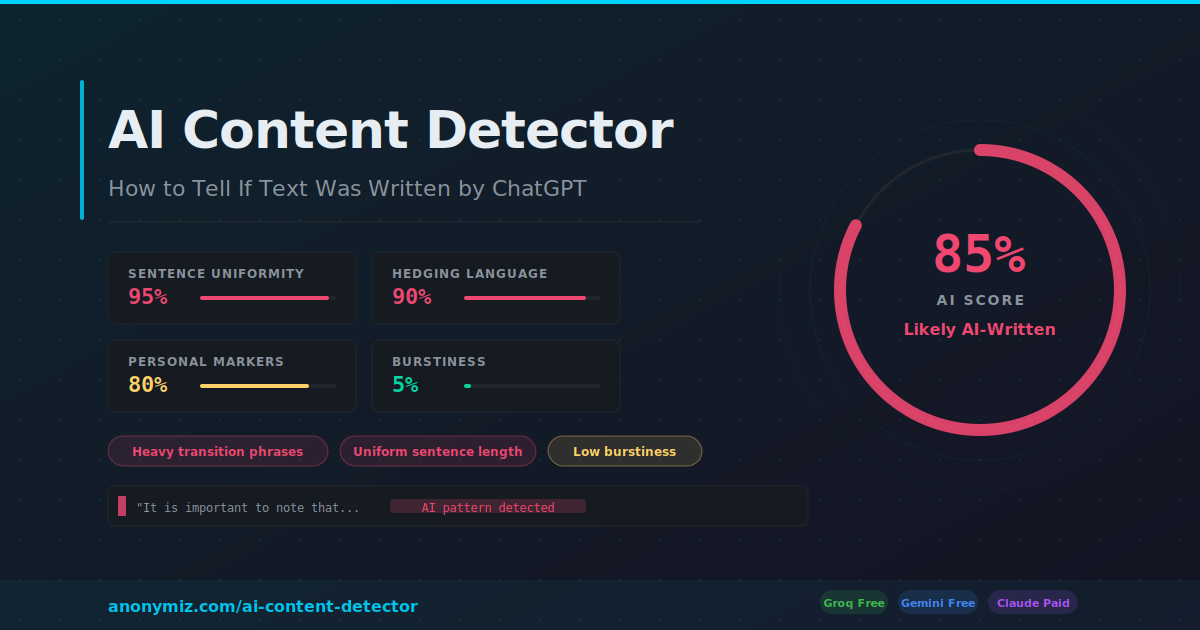
- A breakdown of which patterns triggered the score
- Annotated text showing the specific sentences that read as AI-written
- A recommendation on whether the text needs further editing
For context: a score below 35% is generally considered in the human range. 35–65% is uncertain — could be AI-assisted or just formal writing. Above 65% is where most academic detectors will flag text as likely AI-generated.
What to Do If Your Score Is High
If your score comes back above 65%, here are the most effective things to do:
Add one personal example per section. The biggest difference between AI text and human text is specific personal detail. Replace "research suggests" with something you actually observed or experienced. Even one specific detail per section significantly lowers AI scores.
Vary your sentence lengths. Read your text aloud. If every sentence feels roughly the same length, that is a problem. Add short punchy sentences after long ones. Break up long sentences. Change the rhythm.
Remove transition words. Delete every "furthermore", "moreover", "additionally" and "it is important to note". Read it without them. Usually the text flows better and reads as more natural.
Use the Humanize tool. If you need to process a longer piece quickly, our Humanize AI Text tool rewrites AI-patterned text with more natural language. Use it as a starting point, then add your own personal voice on top.
A Word on Academic Integrity
Using AI to fully write your assignments and submit the output as your own work is academic dishonesty — the same as paying someone else to write it for you. But using AI as a research tool, a brainstorming partner, or a first-draft generator that you then substantially rewrite is a much more defensible position, and one that many institutions are moving toward accepting.
The key is that the final submitted work should represent your thinking, your analysis and your voice. If you can explain and defend every claim in your submission, you are probably in a defensible position. If you could not explain how a paragraph was produced, that is worth reflecting on.
Check Before You Submit
The whole process — paste, check, edit, recheck — takes about ten minutes for a typical essay. It is worth those ten minutes. Use our free AI Essay Detector to check your work now, before anyone else does.