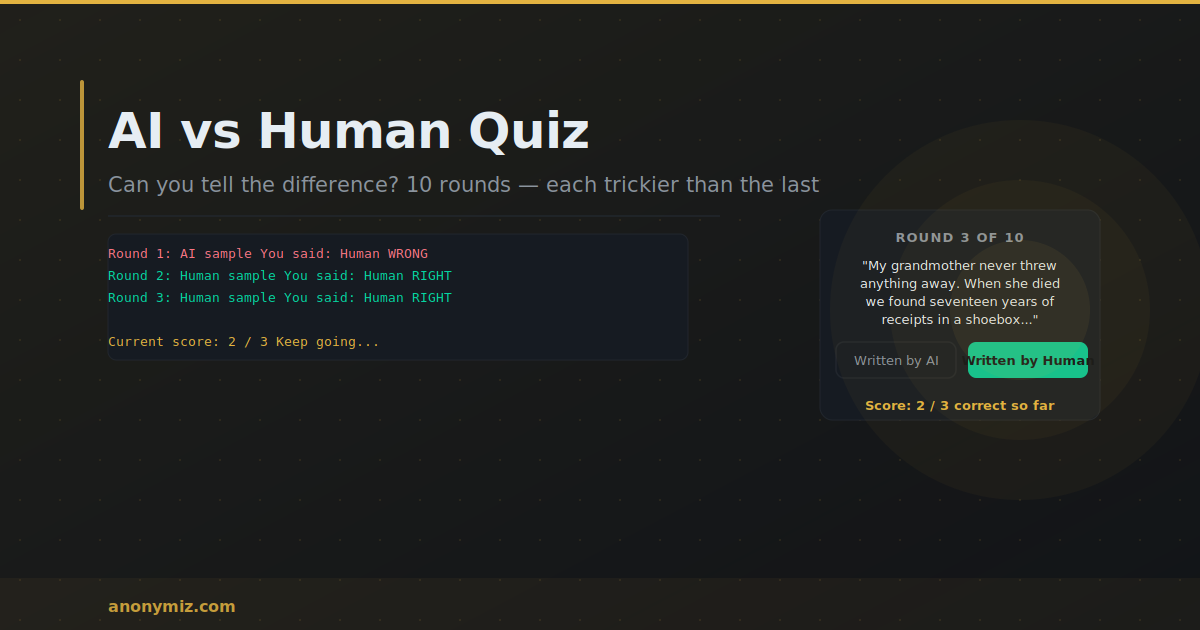
Most people think they can spot AI writing. Most people are wrong. The patterns are subtler than you think, the best AI output is better than you expect, and some of the most distinctively human writing looks nothing like what you imagine "human writing" looks like. The AI vs Human Writing Quiz will test you across ten rounds — and most people score between 5 and 7 out of 10.
Take the Quiz First
Before reading the rest of this post, take the quiz at anonymiz.com/ai-vs-human-quiz. It takes about three minutes. Each round shows you a short passage and asks one question: AI or human? You will get instant feedback after each round explaining what gave it away. Your final score comes with a breakdown of what you got right, what you missed, and which patterns fooled you.
Go take it now. The rest of this post will make more sense after you have a score to reflect on.
What Your Score Actually Means
| Score | What It Means |
|---|---|
| 0 to 3 out of 10 | Your instincts are calibrated backwards — the things that feel human to you are AI signals, and vice versa |
| 4 to 6 out of 10 | You are at chance level — your gut is not reliably useful for detection. Time to learn the actual patterns. |
| 7 to 8 out of 10 | You have good instincts and are picking up real signals — probably noticing sentence rhythm and personal detail |
| 9 to 10 out of 10 | You are very calibrated — you understand how AI writing differs statistically, not just stylistically |
The Passages That Fool People Most
The one that seems too human to be real
Readers consistently misidentify the most distinctive human writing as AI. Why? Because it is so specific, so personal, and so odd that it does not match people's mental model of "good writing." A passage about a grandmother's seventeen years of annotated supermarket receipts reads as unreal — too specific, too strange. It must be made up. It must be AI. It is not. That specificity is exactly what makes it human.
AI cannot know your grandmother. It cannot know about the shoebox under the bed. It cannot know what "Good cheese, expensive" written in cramped handwriting feels like. Every detail in that passage required a real memory. AI generates plausible generalities. Humans generate specific truths.
The one that is clearly AI but feels authoritative
The passages that fool people in the other direction are typically polished, confident, and well-structured — exactly what "good writing" is supposed to look like. "Artificial intelligence has fundamentally transformed the way we approach problem-solving in the modern era." That is a perfect opening sentence by conventional standards. It is also 100% AI. The perfection is the tell.
The mixed passage trap
Some passages are written by a human but edited with AI assistance, or started with AI and heavily rewritten. These genuinely occupy a middle ground. They have AI structural patterns but human-specific details inserted. The quiz includes a few of these and they are the hardest — intentionally so.
The 5 Patterns That Experts Look For
1. Specificity of detail
Human writing contains details that have no business being there — seventeen years of receipts, the cramped handwriting, the specific comments. AI writing contains details that are appropriately illustrative — "many businesses", "a recent study found", "experts agree". AI picks the detail that proves the point. Humans remember the detail that stuck with them.
2. Sentence rhythm variance
Read any passage aloud and tap your finger to the rhythm. AI writing has a metronomic beat — every sentence roughly the same weight. Human writing has bursts and silences. Short. Then long sweeping sentences that build through multiple clauses toward a point that lands somewhere unexpected. Then short again.
3. Opinions and taking sides
AI writing hedges everything. It presents "both sides." It notes that "while X has advantages, it also has limitations." Human writers have opinions. They think one thing is better than another and they say so. A passage that carefully balances every claim is almost certainly AI.
4. The sound of thinking
Human writing contains thinking in progress — self-corrections, qualifications that come from genuine uncertainty rather than rhetorical balance, moments where the writer changes direction mid-thought. AI writing presents a conclusion and supports it. Human writing discovers a conclusion while writing.
5. What is missing
AI writing never mentions failure, embarrassment, uncertainty, or not knowing something. Human writers do all of these constantly. If a passage about learning something new contains zero moments of difficulty, confusion, or setback — that is an AI signal.
Why the Quiz Is Harder Than Just Using a Detector
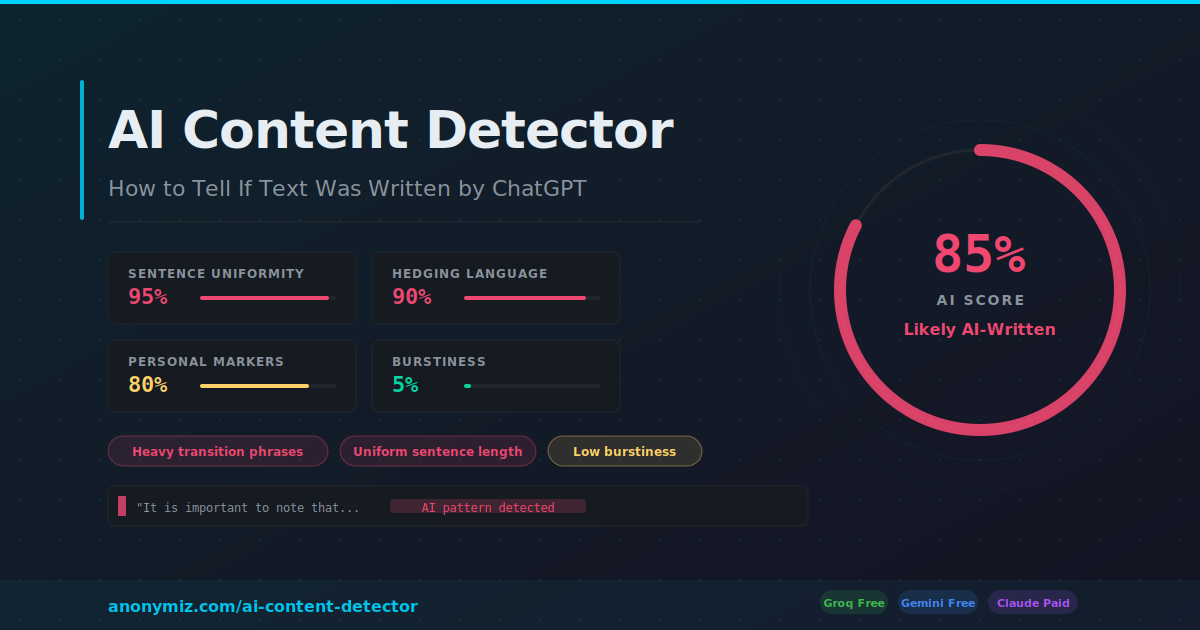
The AI Content Detector analyses statistical patterns across hundreds of data points simultaneously. Your brain does not. When you read a passage and make a judgment call, you are processing a tiny fraction of the available signal — mostly surface features like "does this sound formal" and "are there transition phrases." The quiz trains you to look at the actual diagnostic signals: sentence length variance, specificity, personal markers, burstiness.
After taking the quiz a few times, most people find their score improves significantly — not because the quiz gets easier, but because they are now looking at the right things.
Share Your Score
The quiz is designed to be shared. If you scored 8 or higher, share it — most people will score lower than you and will want to know why. If you scored 5 or lower, share it — "I only got 5/10 and I thought I was good at this" is a compelling hook. The link is anonymiz.com/ai-vs-human-quiz — free, no account needed, three minutes.
Frequently Asked Questions
Are the passages in the quiz real AI output and real human writing?
Yes. The AI passages were generated by major LLMs including ChatGPT and Claude. The human passages are genuine human writing selected to represent a range of styles, topics, and quality levels.
Does my score improve with practice?
Yes, significantly. Users who take the quiz multiple times typically improve by 2 to 3 points as they internalise the actual diagnostic signals rather than relying on surface impressions.
Is there a way to get better at spotting AI writing?
Yes — use the AI Content Detector on texts you read and check the signal breakdown. Over time you will calibrate your intuition against actual statistical patterns. The quiz combined with the detector is the fastest way to develop reliable AI detection instincts.