Academic integrity has never been harder to maintain. Since ChatGPT launched in November 2022, students at every level have used it to generate essays, assignments, research papers, and discussion posts. Teachers, professors, and institutions are still catching up. This guide covers what AI essay detectors can and cannot do, how to use one responsibly, and what to look for when reading an essay you suspect was AI-generated.
Can You Actually Detect a ChatGPT Essay?
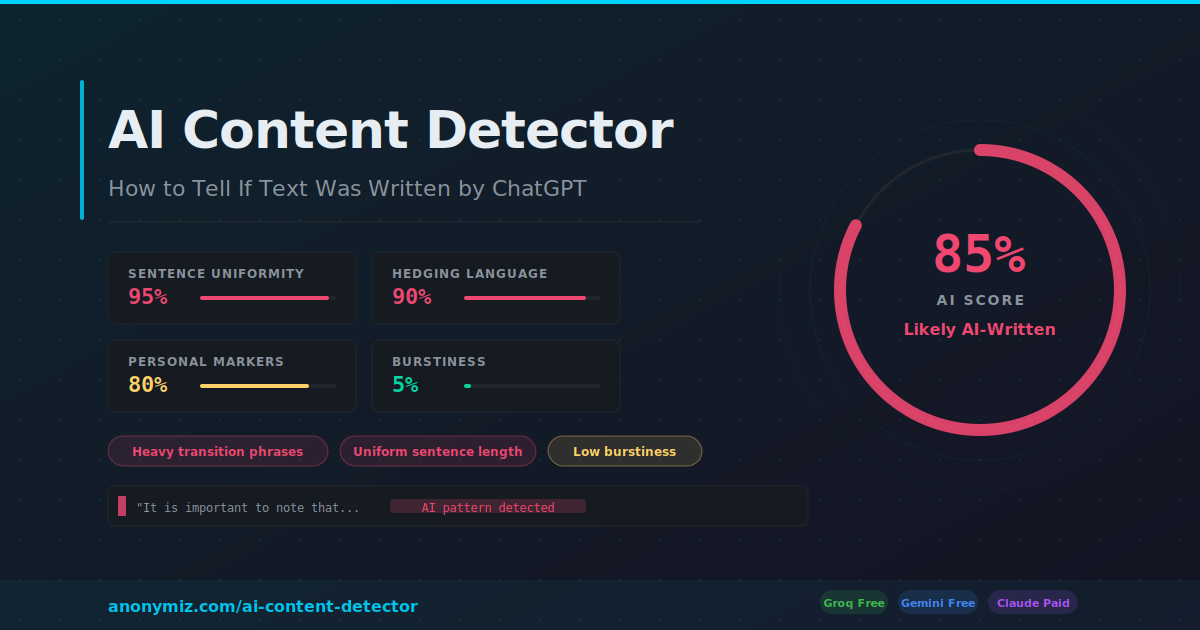
Yes — with meaningful accuracy, but not with certainty. AI essay detectors analyse statistical patterns in writing that large language models consistently produce: uniform sentence lengths, low perplexity word choices, heavy use of transition phrases, and an absence of personal voice or specific lived experience. These patterns are detectable. No detector is infallible, but a strong AI signal across multiple metrics is meaningful evidence.
The honest answer is that AI detection is a probability assessment, not a lie detector. A score of 88% means "this text exhibits strong AI writing patterns across six measured dimensions." It does not mean "this was definitely written by ChatGPT." That distinction matters enormously in how you act on the result.
How the Anonymiz AI Essay Detector Works
The Anonymiz AI Essay Detector is built specifically for academic use. Paste any essay, paragraph, or assignment and it analyses six dimensions:
- Sentence Uniformity — measures variance in sentence length. Human student writing has high variance; AI writing clusters tightly around 15 to 25 words per sentence.
- Hedging Language — counts AI-characteristic phrases like "it is important to note", "furthermore", "this has significant implications". Students rarely write this way naturally.
- Perplexity Score — measures how predictable each word choice is. AI picks the statistically safest word every time. Human writers, especially students, make more unexpected choices.
- Personal Markers — detects the presence or absence of first-person voice, personal experience, named specific examples, and emotional language. AI almost never includes genuine personal detail.
- Burstiness — measures whether sentence complexity varies naturally. Human writers have bursts of complex and simple sentences. AI maintains consistent medium complexity throughout.
- Vocabulary Diversity — measures the ratio of unique words to total words. AI reuses vocabulary more than humans do.
What Score Should You Act On?
| Score Range | Interpretation | Recommended Action |
|---|---|---|
| 0 to 30% | Strongly human writing patterns | No action needed |
| 30 to 50% | Mixed signals — formal or ESL writing | Compare against other student work |
| 50 to 70% | Notable AI patterns present | Have a conversation with the student |
| 70 to 85% | Strong AI signals across multiple dimensions | Request explanation and oral defence |
| 85 to 100% | Very strong consistent AI patterns | Formal review process with supporting evidence |
The False Positive Problem — Who Gets Wrongly Flagged
This is the most important section for educators. Certain types of genuinely human writing consistently score higher on AI detectors:
- ESL (English as a Second Language) students — students who learned English from textbooks often write in a more formal, structured, uniform style that resembles AI output. This is the highest-risk false positive group.
- Highly structured academic writers — students who follow academic writing guidelines very closely produce text with formal transitions and consistent structure that can trigger AI flags.
- Students with certain writing disabilities — some students use assistive technology or very deliberate, structured writing processes that can produce uniform output.
- Students in highly formulaic disciplines — lab reports, legal case analyses, and business case studies often follow rigid formats that AI detectors can misread.
This is exactly why the Anonymiz AI Essay Detector includes a permanent academic disclaimer: "No AI detector is 100% accurate. Use this as supporting evidence — not as definitive proof. Always combine with other assessment methods before making any decisions."
How to Use AI Detection Responsibly
- Use it as one data point, not the conclusion. A high AI score should open a conversation, not close a case. Combine it with process evidence (drafts, notes, in-class writing samples) before drawing conclusions.
- Run multiple pieces of the same student's work. Compare the AI score of the suspected essay against other known-genuine work from the same student. A dramatic difference is more meaningful than an absolute score.
- Require minimum word counts. The tool recommends 150+ words. Short texts do not provide enough statistical signal for reliable detection. Never apply detection to responses under 100 words.
- Ask process questions. Ask the student to explain their argument, expand on a specific paragraph, or write a related paragraph in front of you. A student who wrote the essay can do all of these. A student who did not usually cannot.
- Document everything. Before taking any formal action, document the AI score, the specific passages that flagged, and the student conversation. This protects both you and the student.
Frequently Asked Questions
Does it work for all subjects?
Yes — the detector analyses writing patterns, not subject matter. It works equally well on history essays, biology reports, English literature analyses, and business case studies.
What about essays that mix AI and human writing?
Mixed essays — where a student wrote some sections and used AI for others — typically score in the 40 to 65% range. The tool highlights the specific sentences that triggered AI flags, making it possible to identify which sections are most suspect.
Is it free for teachers?
Yes — the Groq and Gemini engine options are completely free with no account required. Teachers can check as many essays as needed.
Can students use it to check their own work?
Absolutely. Students who used AI assistance can run their draft through the detector before submission to understand how much it reads as AI-generated, and then use the Humanize AI Text tool to revise sections that score highly.
The Bottom Line for Educators
AI essay detectors are a useful tool in a larger academic integrity strategy. They work best when combined with process-based assessment, in-class writing components, oral examination, and honest conversations with students about AI use policies. Used thoughtfully, they provide meaningful supporting evidence. Used as a final verdict, they create the conditions for injustice. The Anonymiz AI Essay Detector is free, requires no account, and includes the academic disclaimer that every responsible detector should have.