
Every teacher, editor, employer, and publisher is asking the same question right now: did a human write this, or did ChatGPT? AI-generated content has exploded since late 2022, and distinguishing it from human writing has become one of the most important — and most misunderstood — skills of the decade.
This guide explains exactly how AI content detectors work, what signals they look for, which patterns ChatGPT and other LLMs consistently produce, and how to use a free detector to check any text instantly.
Why AI Writing Is Detectable at All
Large language models like ChatGPT, Claude, Gemini, and Llama all generate text using the same fundamental process: they predict the next most statistically likely word, over and over, until the response is complete. This process has a fingerprint.
Human writers are unpredictable. They go off on tangents, use obscure words, make grammatical choices that technically break rules, inject personal anecdotes, and vary their sentence rhythm dramatically — short punchy lines followed by much longer, flowing, complex constructions that build on each other.
AI writers are not unpredictable. Every word choice is statistically optimal. Every sentence lands in a comfortable, readable range. The transitions are always smooth. The vocabulary is always appropriate. And that perfection, paradoxically, is exactly what gives it away.
The 6 Key Signals AI Detectors Measure
1. Sentence Uniformity
Read any paragraph of ChatGPT output and count the sentence lengths. They will cluster tightly around 15 to 25 words. Human writing has wild variance — some sentences are three words long, others run for sixty words across multiple clauses. AI writing stays in the Goldilocks zone consistently, because the model was trained to produce clear, readable text and never learned that sometimes you need a single-word sentence for impact. Period.
2. Hedging and Transition Phrases
AI models are trained on enormous amounts of academic and professional writing, and they reproduce its verbal tics obsessively. Watch for:
- "It is important to note that…"
- "Furthermore…" / "Moreover…" / "Additionally…"
- "In conclusion…" / "To summarise…"
- "It is worth mentioning that…"
- "This has significant implications for…"
- "Delve into…" / "A nuanced understanding…" / "A comprehensive approach…"
No single human uses all of these phrases in one document. ChatGPT uses all of them in one paragraph.
3. Perplexity — How Predictable Is the Word Choice?
Linguists measure text "perplexity" — essentially how surprised a language model is by each word choice. Human text has high perplexity because humans make unexpected word choices. AI text has very low perplexity because the model always chooses the most statistically expected word. Detectors exploit this: if every word in a piece of writing was the obvious choice, it was probably written by a machine.
4. Burstiness
Human writers have writing rhythms — bursts of complex ideas followed by simple, declarative sentences. Academic research has formalised this as "burstiness." AI-generated text has almost no burstiness. Its complexity is metronomically consistent. Sentence after sentence arrives at roughly the same cognitive weight. That consistent medium complexity is one of the strongest single signals of AI authorship.
5. Personal Markers and Specificity
Human writers reference things only they would know: the specific city they visited, the exact year something happened to them, the name of a colleague, the memory of a smell. ChatGPT avoids all of this. It cannot know your personal experiences, so it writes around them. The result is text that is impersonal, generic, and free of the specific concrete details that make human writing feel alive. When a piece of writing about "remote work challenges" never once mentions a specific person, company, software tool, or incident — that is an AI signal.
6. Vocabulary Diversity (Type-Token Ratio)
Linguists measure vocabulary richness via the type-token ratio: unique words divided by total words. Human writers naturally use a wide vocabulary with true synonyms. AI models show lower vocabulary diversity — they reuse phrases and prefer the most common word for each concept. A piece of writing that uses "important" twelve times when a human would have written "crucial", "vital", "critical", "essential", and "significant" at different points is showing AI patterns.
How to Use an AI Content Detector
The fastest way to check any text is to use the Anonymiz AI Content Detector. Here is how it works:
- Paste your text — any article, essay, email, blog post, or paragraph of at least 50 words
- Choose your AI engine — Groq (free, fastest), Gemini (free, Google), or Claude (highest accuracy)
- Click Analyse Text — results appear in seconds
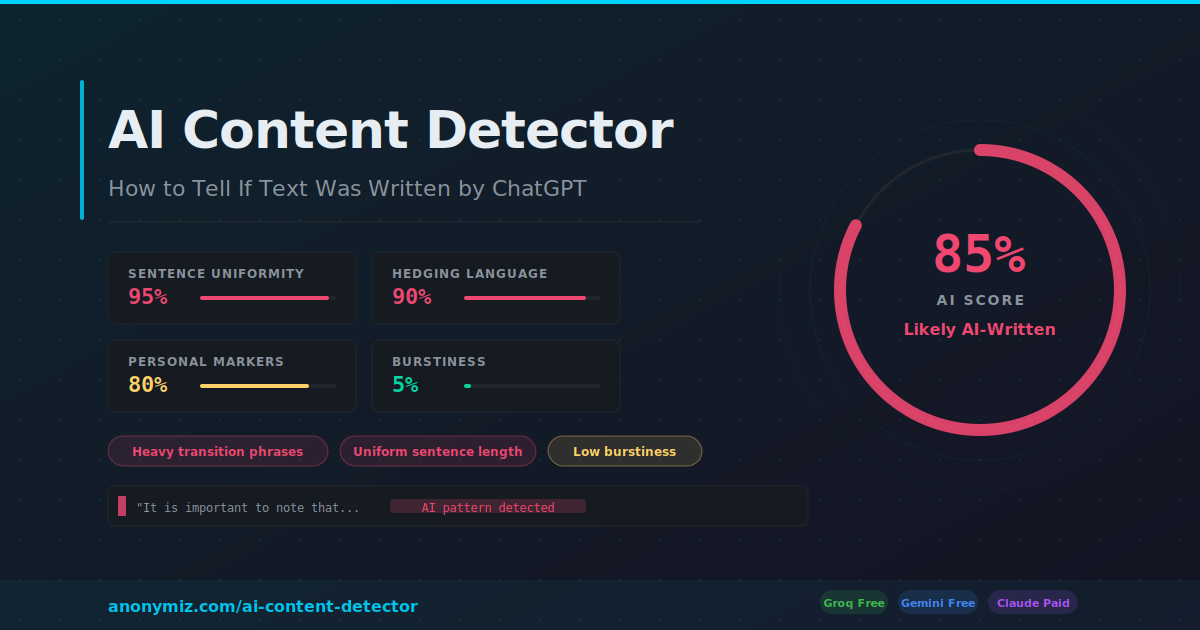
- Read the breakdown — you get an overall AI probability score from 0 to 100, plus individual scores for each of the six signals above, and the specific sentences that triggered the AI flags highlighted in red
The tool is completely free for the Groq and Gemini engines, with no account or signup required.
What a High AI Score Actually Means
A score of 70% or above means the text shows strong, consistent AI patterns across multiple signals. A score of 40 to 70% is the mixed zone — text that was written by AI but then edited by a human, or human text that happens to be very formal and structured. A score below 40% indicates strongly human writing patterns.
No detector is 100% accurate. Here is what can cause false results:
- False positives (human flagged as AI): Very formal academic writing, legal documents, or text written by non-native English speakers who write in a more uniform, textbook style
- False negatives (AI flagged as human): AI text that has been substantially edited and humanised, or AI text deliberately prompted to include personal anecdotes and varied sentence lengths
Use the score as strong supporting evidence, not a definitive verdict.
Can You Tell Just by Reading?
Sometimes yes. These are the strongest human-readable signals to look for:
- The "nothing sandwich": The introduction says what it will say, the body says it, and the conclusion says what it said. This three-layer structure with zero original observation in any layer is a classic ChatGPT format.
- No opinion: Ask ChatGPT which is better — X or Y — and it will say both have merits and drawbacks. Human writers have opinions. AI writing hedges everything to avoid being wrong.
- No failure: Human writing includes mistakes, corrections, moments of uncertainty, and admissions of ignorance. AI writing is uniformly confident and complete.
- Generic examples: Humans use specific examples from their own experience. AI uses the same ten examples (Uber, Netflix, Tesla, Amazon, "a small business owner", "a student") because those appear most frequently in training data.
- The em dash overuse: ChatGPT has a statistically unusual fondness for em dashes — placing them — in sentences — where a human would use commas or restructure entirely.
Which AI Models Are Hardest to Detect?
All current major LLMs — ChatGPT (GPT-4o), Claude, Gemini, Llama 3, Mistral — share the same fundamental statistical patterns because they are all trained using similar methods on overlapping datasets. None is dramatically harder to detect than another when producing default output.
The hardest AI text to detect is AI text that has been deliberately "humanised" — either by prompting the model to write more informally, or by a human editor who rewrites the most obviously AI-sounding passages. A skilled human editor can reduce a piece of AI text's detection score from 85% to 30% in under ten minutes.
Tips for Educators Using AI Detectors
If you are using AI detection to evaluate student work, keep these principles in mind:
- Use it as one signal among many. A high AI score should prompt a conversation, not an automatic penalty. Ask the student to explain their reasoning process, discuss specific passages, or write something in front of you.
- Run multiple pieces of the student's work. Compare the AI score of the suspected piece against other work from the same student. A dramatic difference is more meaningful than an absolute score.
- Use at least 150 words per analysis. Short texts do not provide enough statistical signal for reliable detection. A 60-word essay paragraph will produce unreliable results.
- Understand the false positive risk. ESL students, students with very formal writing styles, and students who write in highly structured academic formats may score higher than expected.
Frequently Asked Questions
Does it work on GPT-4o specifically?
Yes. GPT-4o, GPT-3.5, Claude 3, Gemini 1.5, Llama 3, Mistral, Copilot, and all other major LLMs produce the same detectable statistical patterns because they use the same underlying training approach. The detector identifies patterns in the output, not the model identity.
Can I use this for free?
Yes — the Groq and Gemini engine options on the Anonymiz AI Content Detector are completely free with no account required. They use free-tier API access from Groq and Google respectively.
How long should the text be for accurate results?
Minimum 50 words, but 150 to 500 words gives the most reliable results. Below 50 words, there is simply not enough text to measure statistical patterns meaningfully. Above 500 words, you can split the text and check each half separately.
Will it detect AI text that has been paraphrased or edited?
Partially. Light editing — fixing a few word choices or adding a sentence — usually does not significantly reduce the AI score. Heavy editing that changes sentence structure, adds personal details, and varies rhythm substantially can reduce the score significantly. The more a human touches the text, the lower the AI score.
Can it be fooled intentionally?
Yes, with effort. Prompting ChatGPT to "write like a human with varied sentence lengths, personal anecdotes, specific examples, and no transition phrases" produces harder-to-detect text. Adding your own personal experiences and rewriting uniformly structured paragraphs further reduces detectability. However, casual AI-generated content submitted without any humanisation effort is reliably detected.
The Bottom Line
AI content detectors work by measuring the statistical fingerprints that all large language models leave behind — uniform sentence lengths, predictable word choices, hedging phrases, and impersonal writing. No single signal is definitive, but the combination of six measured patterns produces a reliable probability score.
The most important thing to understand is that AI detection is a probability assessment, not a lie detector. A score of 82% means "this text has strong AI writing patterns" — it does not mean "this was 82% written by AI." Use it as a starting point for human judgment, not a replacement for it.
Check any text for free at the Anonymiz AI Content Detector — no account, no signup, results in seconds.